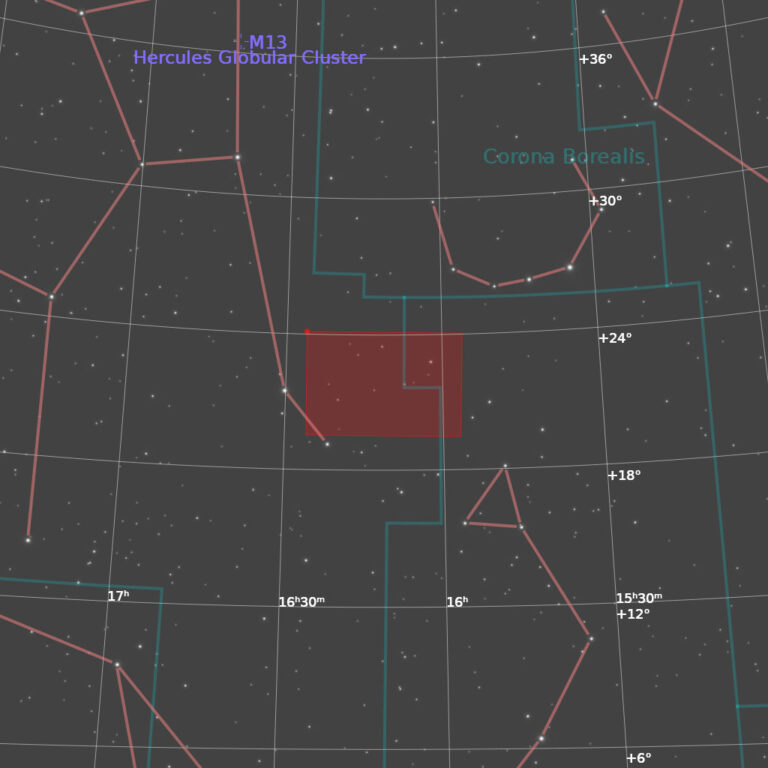
Sharpless 2-73
HII Region, Hercules
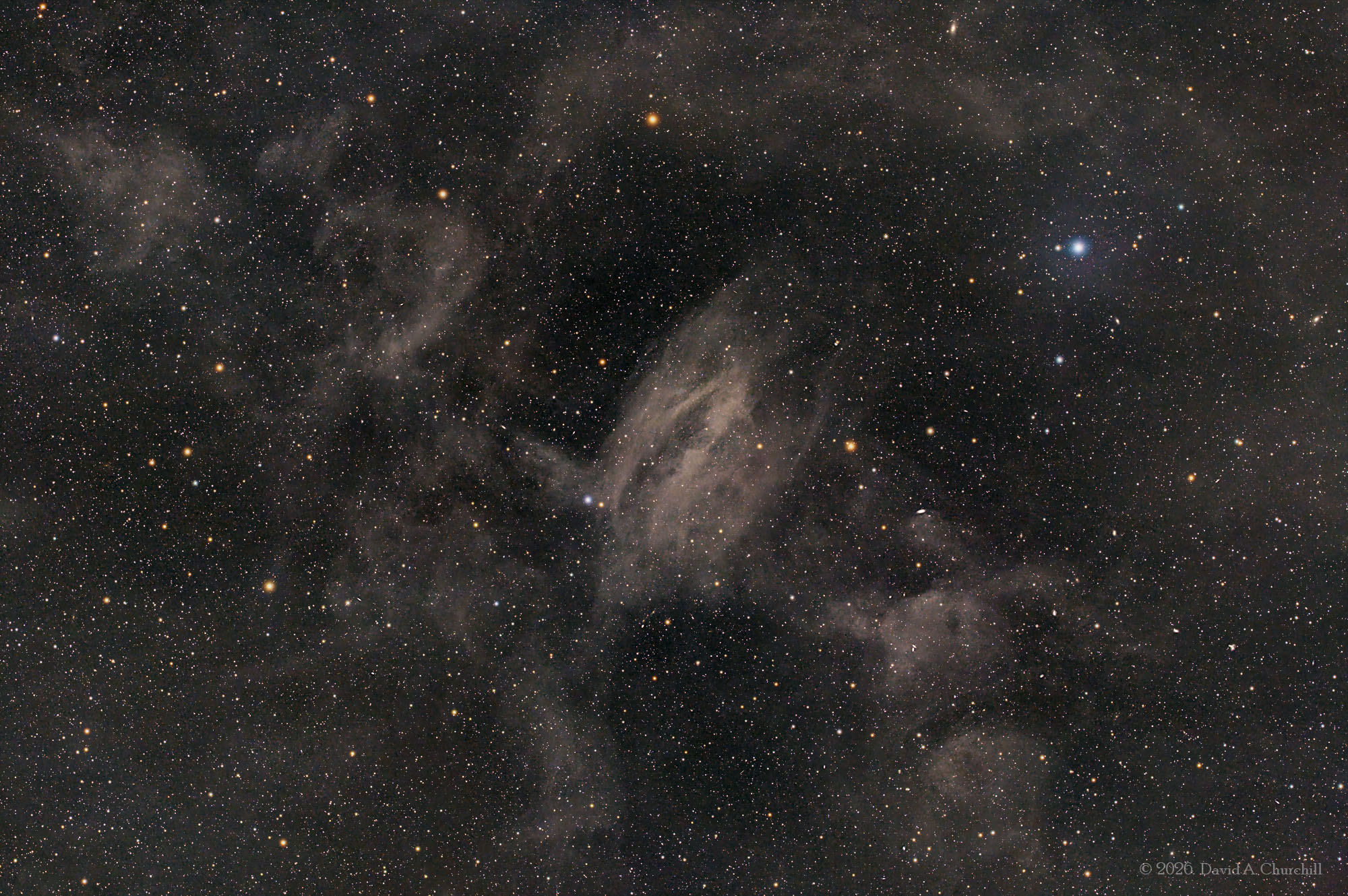
May 2026. Cave Creek Canyon Observatory, Arizona Sky Village
- Description
- Technical
- Links
Sharpless 2-73 (also known as Sh2-73 or LBN 105 and 106) is an HII region seen in the center of this image, located in the constellation Hercules.
Sh2-73 is cataloged in the Sharpless catalog, which is a list of 313 HII regions (emission nebulae) intended to be comprehensive north of declination −27°. (It does include some nebulae south of that declination as well.) The first edition was published in 1953 with 142 objects (Sh1), and the second and final version was published by US astronomer Stewart Sharpless in 1959 with 312 objects. Sharpless also includes some planetary nebulae and supernova remnants, in addition to H II regions.
In 1953 Stewart Sharpless joined the staff of the United States Naval Observatory Flagstaff Station, where he surveyed and cataloged HII regions of the Milky Way using the images from the Palomar Sky Survey. From this work Sharpless published his catalog of HII regions in two editions: the first in 1953, with 142 nebulae; and the second and final edition in 1959, with 312 nebulae.
Sharpless coordinates are based on the star catalogs Bonner Durchmusterung (BD) and Cordoba Durchmusterung (CD), but the second release was adjusted to the 1900 epoch. In the second release, some coordinates for southern hemisphere regions have an uncertainty over 1 minute of arc. This can make them difficult to find, so a revised catalog called BFS (Blitz, Fich and Stark) was released with 65 new regions and about 20 removals. Most of the removed items were the aforementioned nebula or remnants.
The 312 items in Sharpless sometimes overlap with the 110 Messier objects (M), 7,840 objects in the New General Catalogue (NGC), the Caldwell catalogue (itself a “best of” from other catalogues, with 109 items), and the RCW catalog. Contemporary catalogs were Gum and RCW, but they mainly covered the southern hemisphere.
Sh2-73 is cataloged in the Sharpless catalog, which is a list of 313 HII regions (emission nebulae) intended to be comprehensive north of declination −27°. (It does include some nebulae south of that declination as well.) The first edition was published in 1953 with 142 objects (Sh1), and the second and final version was published by US astronomer Stewart Sharpless in 1959 with 312 objects. Sharpless also includes some planetary nebulae and supernova remnants, in addition to H II regions.
In 1953 Stewart Sharpless joined the staff of the United States Naval Observatory Flagstaff Station, where he surveyed and cataloged HII regions of the Milky Way using the images from the Palomar Sky Survey. From this work Sharpless published his catalog of HII regions in two editions: the first in 1953, with 142 nebulae; and the second and final edition in 1959, with 312 nebulae.
Sharpless coordinates are based on the star catalogs Bonner Durchmusterung (BD) and Cordoba Durchmusterung (CD), but the second release was adjusted to the 1900 epoch. In the second release, some coordinates for southern hemisphere regions have an uncertainty over 1 minute of arc. This can make them difficult to find, so a revised catalog called BFS (Blitz, Fich and Stark) was released with 65 new regions and about 20 removals. Most of the removed items were the aforementioned nebula or remnants.
The 312 items in Sharpless sometimes overlap with the 110 Messier objects (M), 7,840 objects in the New General Catalogue (NGC), the Caldwell catalogue (itself a “best of” from other catalogues, with 109 items), and the RCW catalog. Contemporary catalogs were Gum and RCW, but they mainly covered the southern hemisphere.
Telescope: Askar FRA300pro f5
Mount: Astro Physics Mach-1
Camera: ZWO ASI6200MC pro
Guider: ZWO Off-Axis-Guider / ZWO120MM Mini
Filters: None. Integrated ZWO UV/IR Cut Filter Cover
128×5 mins = 640 mins
Total Imaging Time: 10h 40m
Data Imaged remotely on 5 nights during May 2026.
Data acquisition & Processing by David Churchill.
None