Messier 82
Cigar Galaxy. Starburst Galaxy, Ursa Major
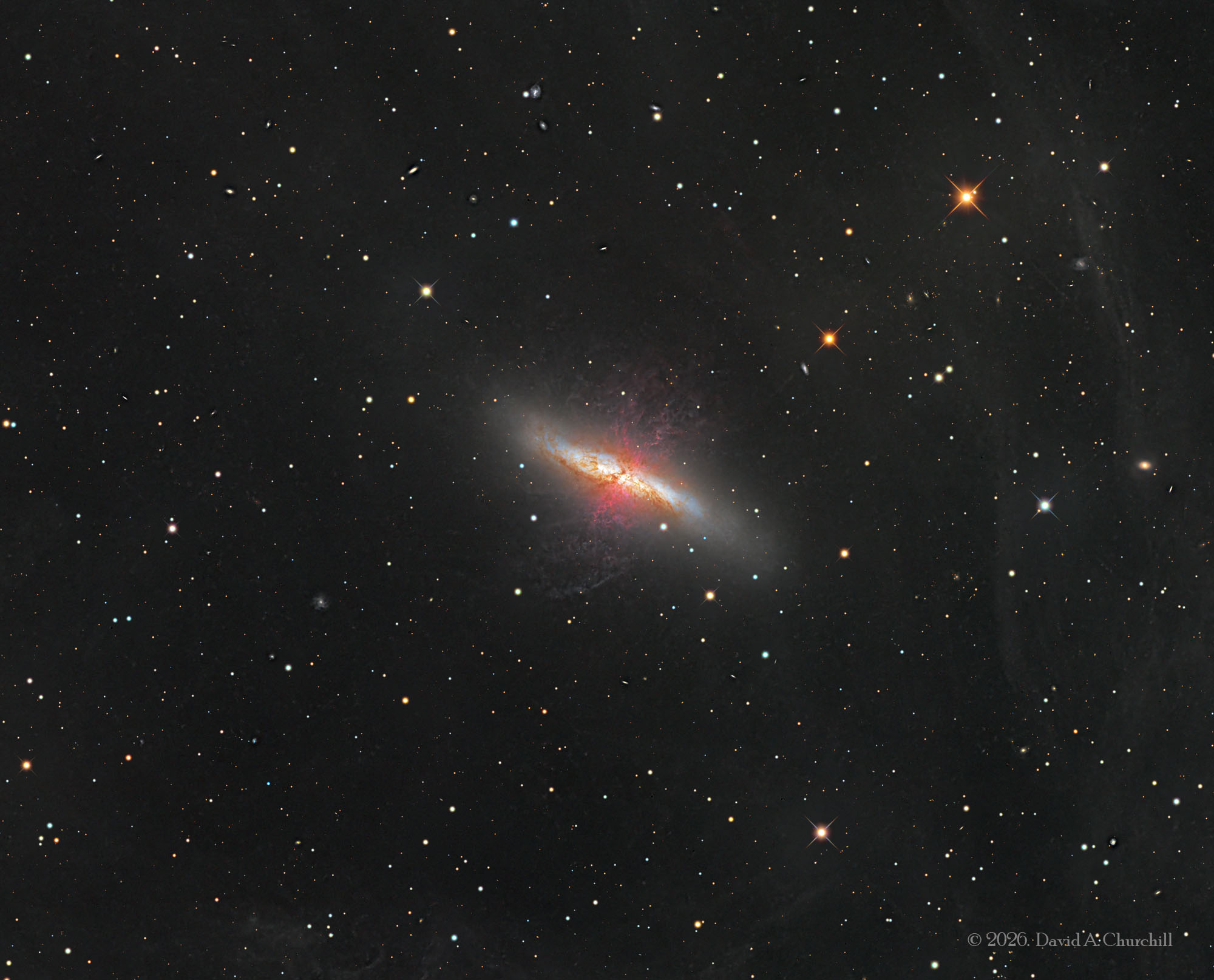
March 2026. Cave Creek Canyon Observatory, Arizona Sky Village
- Description
- Technical
- Links
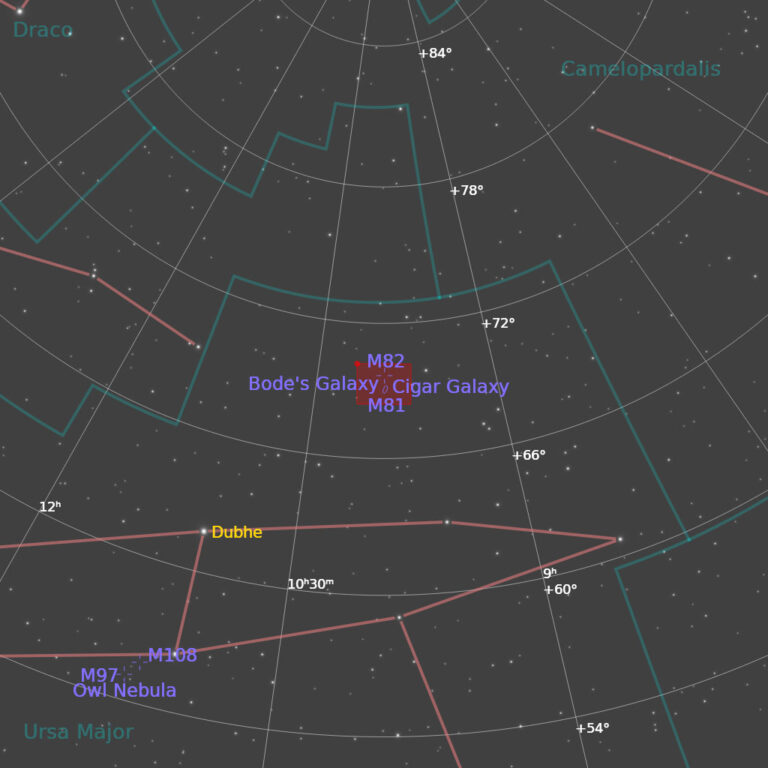
Messier 82 (also known as NGC 3034, Cigar Galaxy or M82) is a starburst galaxy approximately 12 million light-years away in the constellation Ursa Major. It is the second-largest member of the M81 Group, with the D25 isophotal diameter of 12.52 kiloparsecs (40,800 light-years). It is about five times more luminous than the Milky Way and its central region is about one hundred times more luminous. The starburst activity is thought to have been triggered by interaction with neighboring galaxy M81(NGC 3031). As one of the closest starburst galaxies to Earth, M82 is the prototypical example of this galaxy type. SN 2014J, a Type Ia supernova, was discovered in the galaxy on 21 January 2014. In 2014, in studying M82, scientists discovered the brightest pulsar yet known, designated M82 X-2. In November 2023, a gamma-ray burst was observed in M82, which was determined to have come from a magnetar, the first such event detected outside the Milky Way (and only the fourth such event ever detected).
M82, with M81, was discovered by Johann Elert Bode in 1774; he described it as a “nebulous patch”, this one about 3⁄4 degree away from the other, “very pale and of elongated shape”. In 1779, Pierre Méchain independently rediscovered both objects and reported them to Charles Messier, who added them to his catalog.[16]
M82, with M81, was discovered by Johann Elert Bode in 1774; he described it as a “nebulous patch”, this one about 3⁄4 degree away from the other, “very pale and of elongated shape”. In 1779, Pierre Méchain independently rediscovered both objects and reported them to Charles Messier, who added them to his catalog.[16]
Telescope: Planewave Delta Rho 350 f3.0
Mount: Astro Physics 3600GTO “El Capitan”
Camera: ZWO ASI461MM pro / EFW-7
Guider: ZWO OAG-L-68 / ZWO ASI174mm Mini
Filters: Astrodon II 50mm Sq LRGB
L: 114×5 mins = 570 mins, R: 48×5 mins = 240 mins, G: 48×5 mins = 240 mins, B: 48×5 mins = 240 mins
Total Imaging Time: 21h 30m
Data Imaged remotely on 5 nights during March 2026.
Data acquisition & Processing by David Churchill.
None