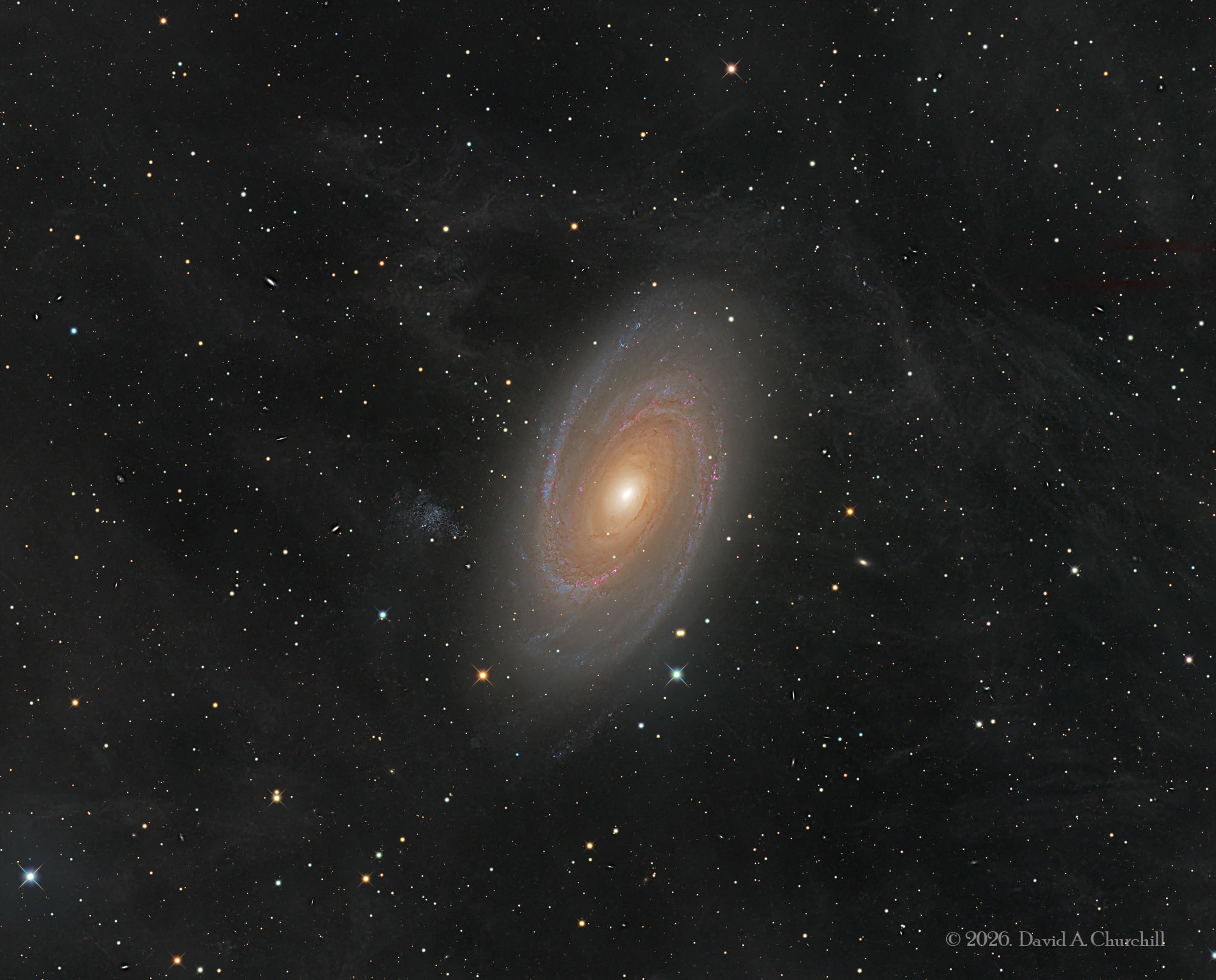
Messier 81
Bode's Galaxy. Grand Spiral Galaxy, Ursa Major
March 2026. Cave Creek Canyon Observatory, Arizona Sky Village
- Description
- Technical
- Links
Messier 81 (also known as M81, NGC 3031 or Bode’s Galaxy) is a grand design spiral galaxy about 12 million light-years away in the constellation Ursa Major. It has a D25 isophotal diameter of 29.44 kiloparsecs (96,000 light-years). Because of its relative proximity to the Milky Way galaxy, large size, and active galactic nucleus (which harbors a 70 million M☉ supermassive black hole), Messier 81 has been studied extensively by professional astronomers. The galaxy’s large size and relatively high brightness also makes it a popular target for amateur astronomers. In late February 2022, astronomers reported that M81 may be the source of FRB 20200120E, a repeating fast radio burst.
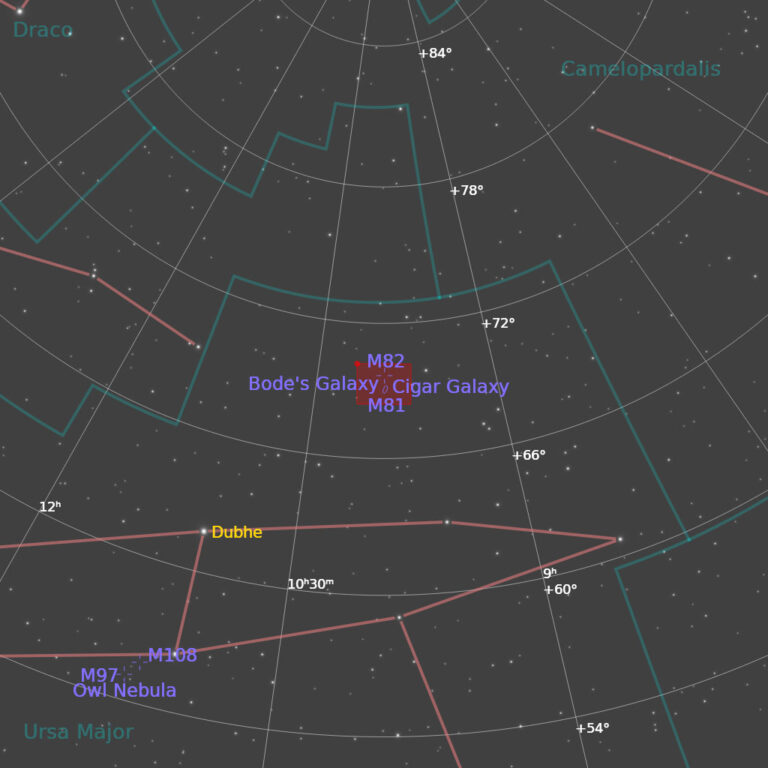
Messier 81 was first discovered by Johann Elert Bode on 31 December 1774. Thus, it is sometimes referred to as “Bode’s Galaxy”. In 1779, Pierre Méchain and Charles Messier reidentified Bode’s object, hence listed it in the Messier Catalogue. The galaxy is to be found approximately 10° northwest of Alpha Ursae Majoris (Dubhe) along with several other galaxies in the Messier 81 Group.
Messier 81 was first discovered by Johann Elert Bode on 31 December 1774. Thus, it is sometimes referred to as “Bode’s Galaxy”. In 1779, Pierre Méchain and Charles Messier reidentified Bode’s object, hence listed it in the Messier Catalogue. The galaxy is to be found approximately 10° northwest of Alpha Ursae Majoris (Dubhe) along with several other galaxies in the Messier 81 Group.
Telescope: Planewave Delta Rho 350 f3.0
Mount: Astro Physics 3600GTO “El Capitan”
Camera: ZWO ASI461MM pro / EFW-7
Guider: ZWO OAG-L-68 / ZWO ASI174mm Mini
Filters: Astrodon II 50mm Sq LRGB
L: 114×5 mins = 570 mins, R: 48×5 mins = 240 mins, G: 48×5 mins = 240 mins, B: 48×5 mins = 240 mins
Total Imaging Time: 21h 30m
Data Imaged remotely on 5 nights during March 2026.
Data acquisition & Processing by David Churchill.
None