Messier 109
The Vacuum Cleaner Galaxy. Barred-Spiral Galaxy, Ursa Major
March 2026. Cave Creek Canyon Observatory, Arizona Sky Village
- Description
- Technical
- Links
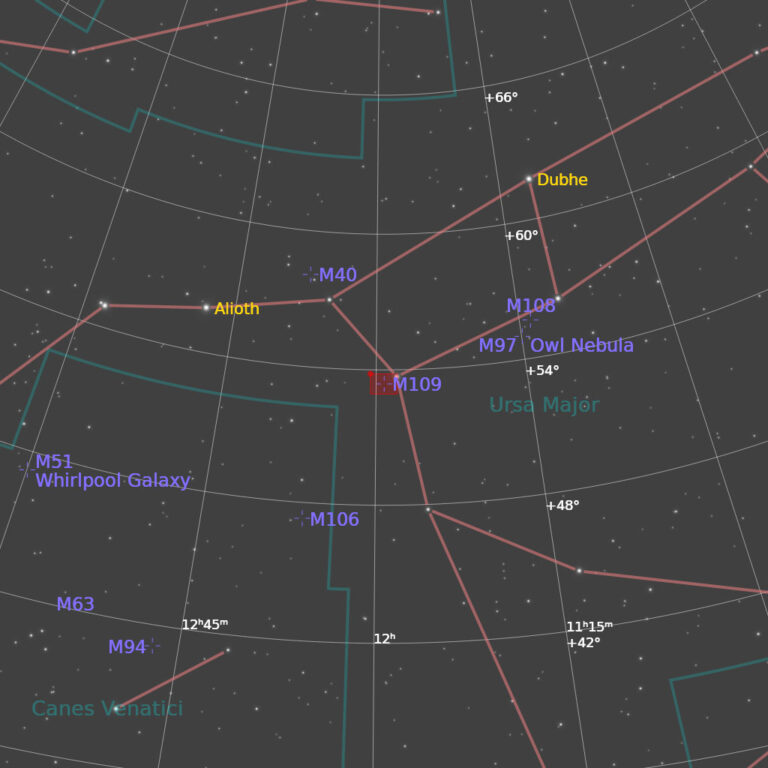
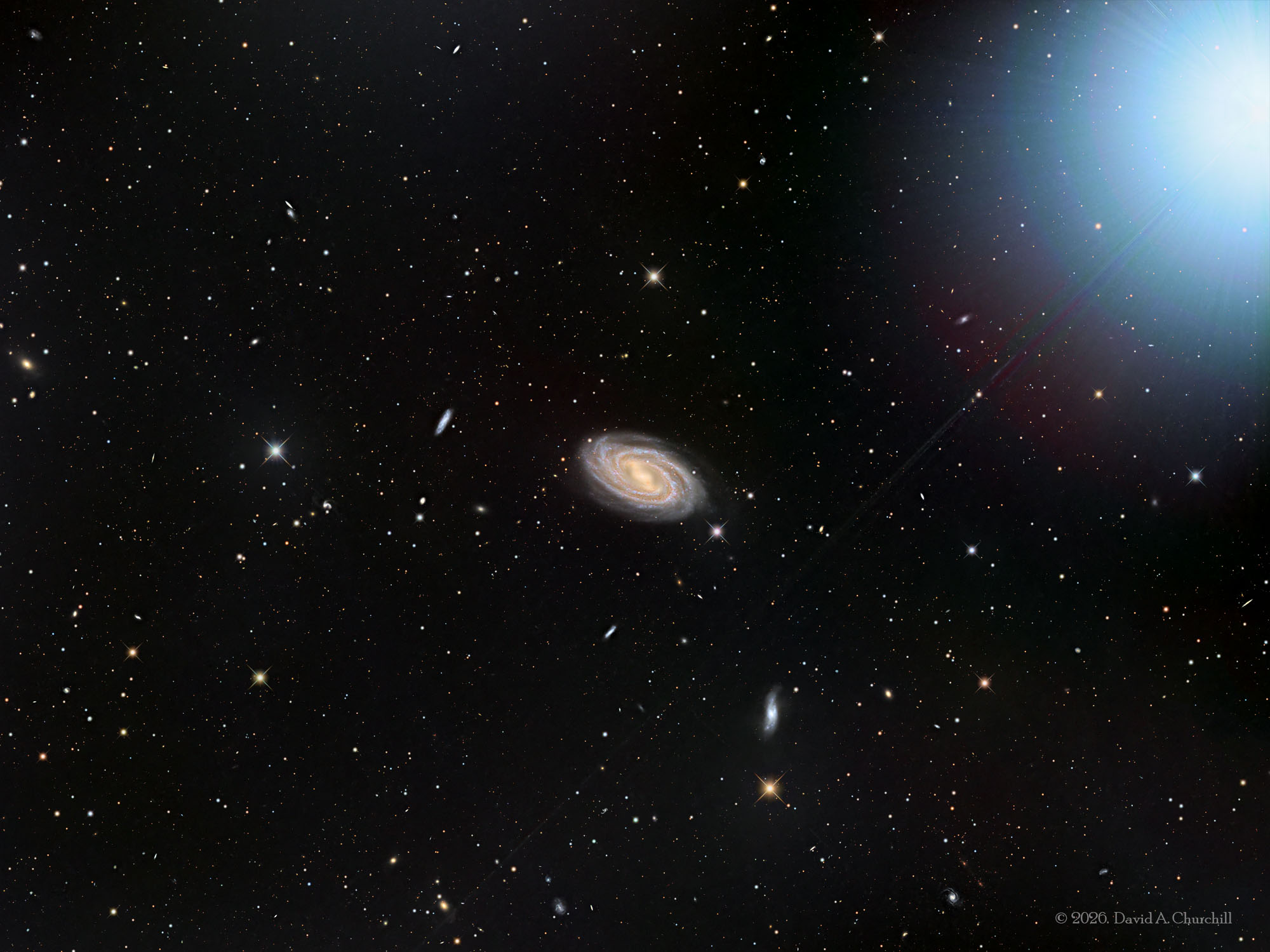
Messier 109 (also known as M109, NGC 3992 or the Vacuum Cleaner Galaxy) is a barred spiral galaxy exhibiting a weak inner ring structure around the central bar approximately 67.2 ± 23 million light-years away in the northern constellation Ursa Major. M109 can be seen south-east of the star Phecda (γ UMa, Gamma Ursa Majoris).
Messier 109 was discovered by Pierre Méchain in 1781. Two years later Charles Messier catalogued the object, as an appended object to his publication. Between the 1920s through the 1950s, it was considered that Messier objects over 103 were not official, but later the additions, further referred target objects from Méchain, became more widely accepted. David H. Levy mentions the modern 110 object catalog while Sir Patrick Moore places the limit at 104 objects but has M105 to 109 listed as addenda. By the late 1970s all 110 objects were in common use among astronomers and remain so to this day. This galaxy is the most distant object in the Messier Catalog, followed by M91. M109 has three satellite galaxies (UGC 6923, UGC 6940 and UGC 6969) and possibly more. M109 is the brightest galaxy in the M109 Group, a large group of galaxies in the constellation Ursa Major that may number over 50.
Messier 109 was discovered by Pierre Méchain in 1781. Two years later Charles Messier catalogued the object, as an appended object to his publication. Between the 1920s through the 1950s, it was considered that Messier objects over 103 were not official, but later the additions, further referred target objects from Méchain, became more widely accepted. David H. Levy mentions the modern 110 object catalog while Sir Patrick Moore places the limit at 104 objects but has M105 to 109 listed as addenda. By the late 1970s all 110 objects were in common use among astronomers and remain so to this day. This galaxy is the most distant object in the Messier Catalog, followed by M91. M109 has three satellite galaxies (UGC 6923, UGC 6940 and UGC 6969) and possibly more. M109 is the brightest galaxy in the M109 Group, a large group of galaxies in the constellation Ursa Major that may number over 50.
Telescope: Planewave Delta Rho 350 f3.0
Mount: Astro Physics 3600GTO “El Capitan”
Camera: ZWO ASI461MM pro / EFW-7
Guider: ZWO OAG-L-68 / ZWO ASI174mm Mini
Filters: Astrodon II 50mm Sq LRGB
L: 85×5 mins = 425 mins, R: 48×5 mins = 240 mins, G: 48×5 mins = 240 mins, B: 48×5 mins = 240 mins
Total Imaging Time: 19h 05m
Data Imaged remotely on 6 nights during March 2026.
Data acquisition & Processing by David Churchill.
None