Messier 13
Great Globular Cluster, Hercules
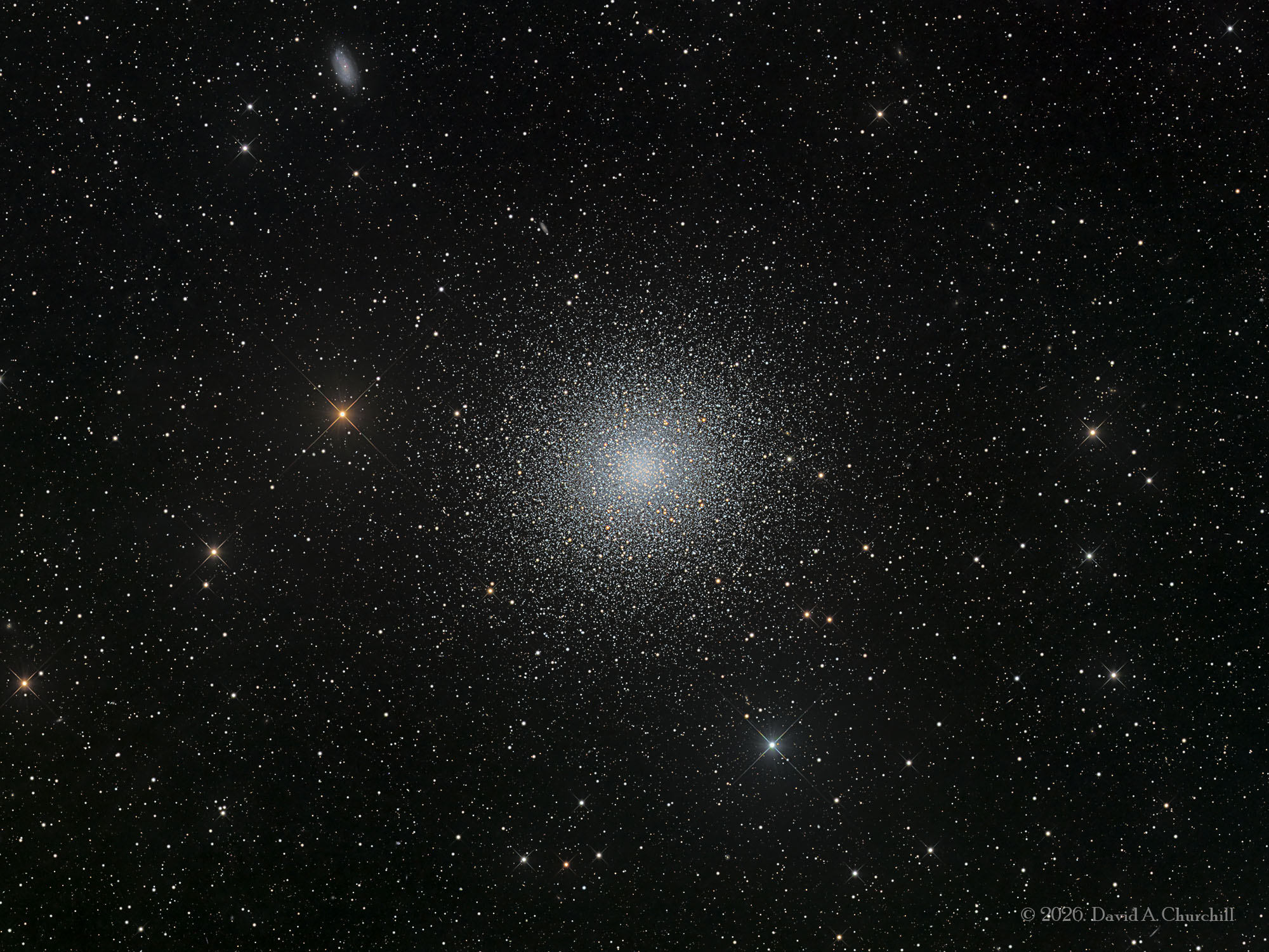
April 2026. Cave Creek Canyon Observatory, Arizona Sky Village
- Description
- Technical
- Links
Messier 13, or M13 (also designated NGC 6205 and sometimes called the Great Globular Cluster in Hercules, the Hercules Globular Cluster, or the Great Hercules Cluster), is a globular cluster of several hundred thousand stars in the constellation of Hercules.
Messier 13 was discovered by Edmond Halley in 1714, and cataloged by Charles Messier on June 1, 1764, into his list of objects not to mistake for comets; Messier’s list, including Messier 13, eventually became known as the Messier catalog. It is located at right ascension 16h 41.7m, declination +36° 28′. Messier 13 is often described by astronomers as the most magnificent globular cluster visible to northern observers.
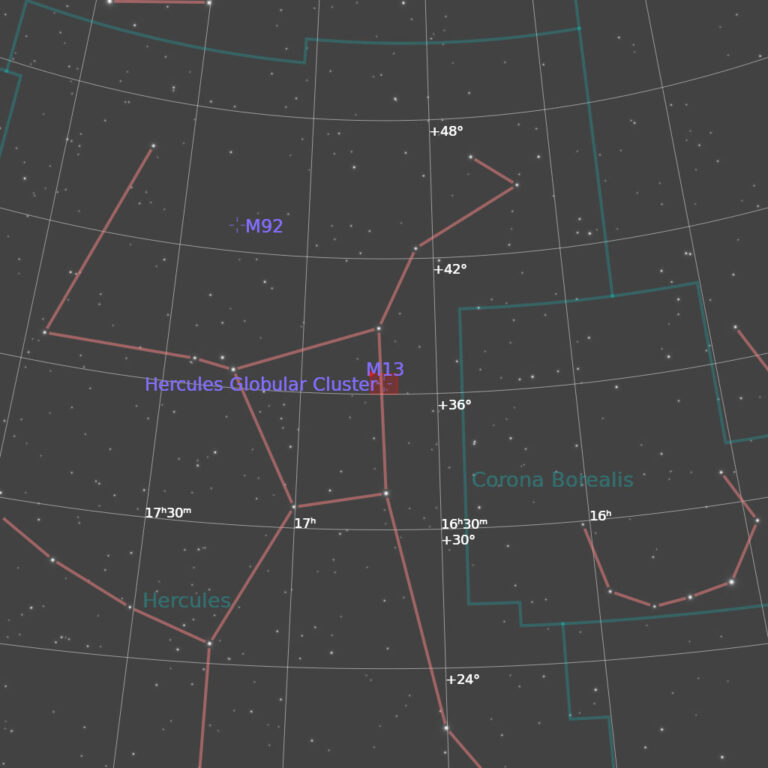
About one third of the way from Vega to Arcturus, four bright stars in Hercules form the Keystone asterism, the broad torso of the hero. M13 can be seen in this asterism 2⁄3 of the way north (by west) from Zeta to Eta Herculis. With an apparent magnitude of 5.8, Messier 13 may be visible to the naked eye with averted vision on dark nights. Messier 13 is prominent in traditional binoculars as a bright, round patch of light. Its diameter is about 23 arcminutes and it is readily viewable in small telescopes. At least four inches of telescope aperture resolves stars in Messier 13’s outer extent as small pinpoints of light. However, only larger telescopes resolve stars further into the center of the cluster. The cluster is visible throughout the year from latitudes greater than 36 degrees north, with the longest visibility during Northern Hemisphere spring and summer.
Nearby to Messier 13 is NGC 6207, a 12th-magnitude edge-on galaxy that lies 28 arcminutes directly northeast. A small galaxy, IC 4617, lies halfway between NGC 6207 and M13, north-northeast of the large globular cluster’s center. At low powers the cluster is bracketed by two seventh-magnitude stars.
About 145 light-years in diameter, M13 is composed of several hundred thousand stars, with estimates varying from around 300,000 to over half a million. The brightest star in the cluster is a red giant, the variable star V11, also known as V1554 Hercules, with an apparent visual magnitude of 11.95. M13 is 22,200 to 25,000 light-years away from Earth, and the globular cluster is one of over one hundred that orbit the center of the Milky Way. The stars in this cluster are firmly in the Population II category, markedly lower in metals than Population I stars like the Sun and most other stars in the Sun’s close proximity. M13 as a whole has only about 4.6% as much iron as the Sun does.
About one third of the way from Vega to Arcturus, four bright stars in Hercules form the Keystone asterism, the broad torso of the hero. M13 can be seen in this asterism 2⁄3 of the way north (by west) from Zeta to Eta Herculis. With an apparent magnitude of 5.8, Messier 13 may be visible to the naked eye with averted vision on dark nights. Messier 13 is prominent in traditional binoculars as a bright, round patch of light. Its diameter is about 23 arcminutes and it is readily viewable in small telescopes. At least four inches of telescope aperture resolves stars in Messier 13’s outer extent as small pinpoints of light. However, only larger telescopes resolve stars further into the center of the cluster. The cluster is visible throughout the year from latitudes greater than 36 degrees north, with the longest visibility during Northern Hemisphere spring and summer.
Nearby to Messier 13 is NGC 6207, a 12th-magnitude edge-on galaxy that lies 28 arcminutes directly northeast. A small galaxy, IC 4617, lies halfway between NGC 6207 and M13, north-northeast of the large globular cluster’s center. At low powers the cluster is bracketed by two seventh-magnitude stars.
About 145 light-years in diameter, M13 is composed of several hundred thousand stars, with estimates varying from around 300,000 to over half a million. The brightest star in the cluster is a red giant, the variable star V11, also known as V1554 Hercules, with an apparent visual magnitude of 11.95. M13 is 22,200 to 25,000 light-years away from Earth, and the globular cluster is one of over one hundred that orbit the center of the Milky Way. The stars in this cluster are firmly in the Population II category, markedly lower in metals than Population I stars like the Sun and most other stars in the Sun’s close proximity. M13 as a whole has only about 4.6% as much iron as the Sun does.
Telescope: Planewave Delta Rho 350 f3.0
Mount: Astro Physics 3600GTO “El Capitan”
Camera: ZWO ASI461MM pro / EFW-7
Guider: ZWO OAG-L-68 / ZWO ASI174mm Mini
Filters: Astrodon II 50mm Sq LRGB
L: 91×2 mins = 182 mins, R: 30×2 mins = 60 mins, G: 30×2 mins = 60 mins, B: 30×2 mins = 60 mins
Total Imaging Time: 6h 02m
Data Imaged remotely on 2 nights during April 2026.
Data acquisition & Processing by David Churchill.
None