
Total Lunar Eclipse (Wide-Field)
2026, March 3
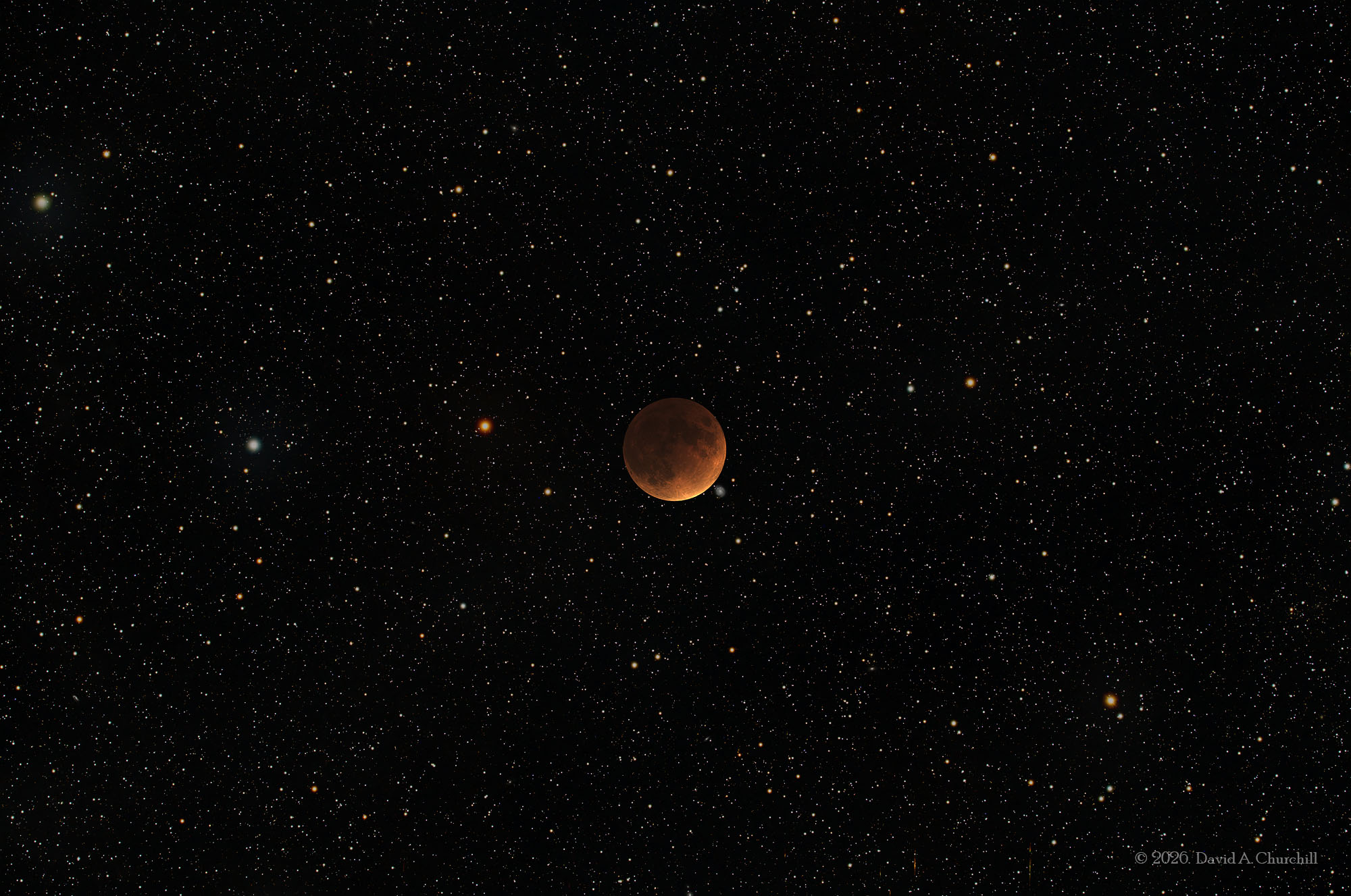
March 2026. Cave Creek Canyon Observatory, Arizona Sky Village
- Overview
- Equipment
- Details
I was fortunate to be visiting our home at The Arizona Sky Village for the Total Lunar Eclipse of March 2026. This was an opportunity to view the event under really dark skies. The totally eclipsed Moon was pretty dark, and when viewed with binoculars appeared as this beautiful red disk suspended amongst a miriad of stars.
The wide-field image below is a composite of a wide-field view of mid-totality with the enhanced star-field which I imaged a few days later. I used the brighter stars from the eclipse image to align both. This combined image is a close representation of how the event appeared to me through the binoculars.
Telescope: Askar FRA300pro f5
Mount: Astro Physics Mach-1
Camera: ZWO ASI6200MC pro
Guider: ZWO Off-Axis-Guider / ZWO120MM Mini
Filters: None. Integrated ZWO UV/IR Cut Filter Cover
Composite Image.
Total Lunar Eclipse: 1s
Star-Field: 63x5m = 315m = 5h 15m
Total Lunar Eclipse imaged remotely on March 3, 2026.
Star-Field imaged remotely on March 8 & 10, 2026.
Data acquisition & Processing by David Churchill.
Total Lunar Eclipse of 2026 March 3
Greatest Eclipse: 11:33:37.0 UT.
Umbral Magnitude: 1.1507
Saros Series: 133, Member: 27 of 71
Eclipse Contacts: P1: 08:44:22 UT. U1: 09:50:00 UT. U2: 11:04:26 UT. U3: 12:02:45 UT. U4: 13:17:10 UT, P4: 14:22:59 UT.
Eclipse Durations: Penumbral: 05h 38m 37s, Umbral: 03h 27m 10s, Total: 00h 58m 19s