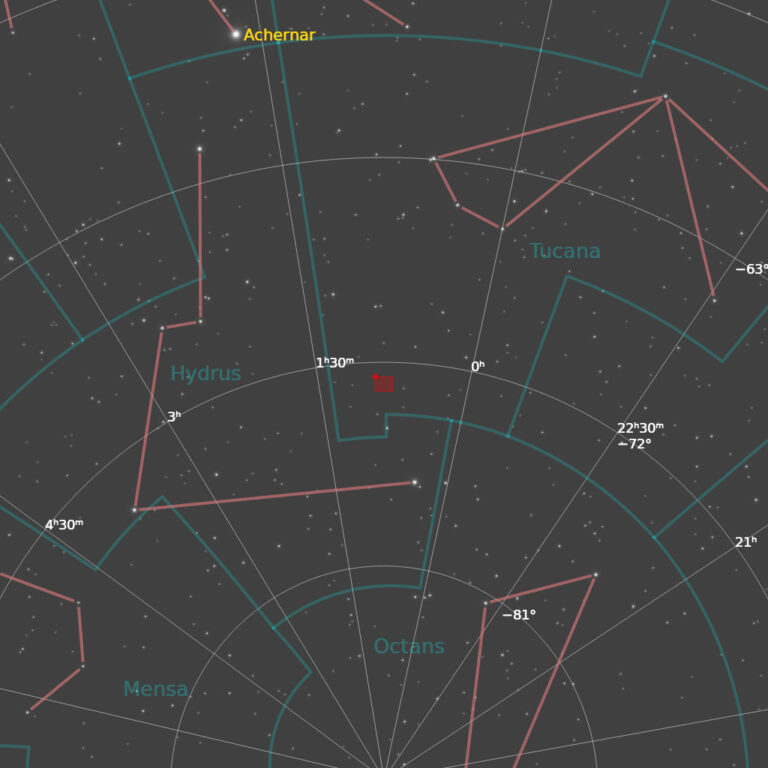
NGC 292
Region within the Small Magellanic Cloud. Diffuse Nebulae & Open Clusters, SMC Tucana
- Description
- Technical
- Links
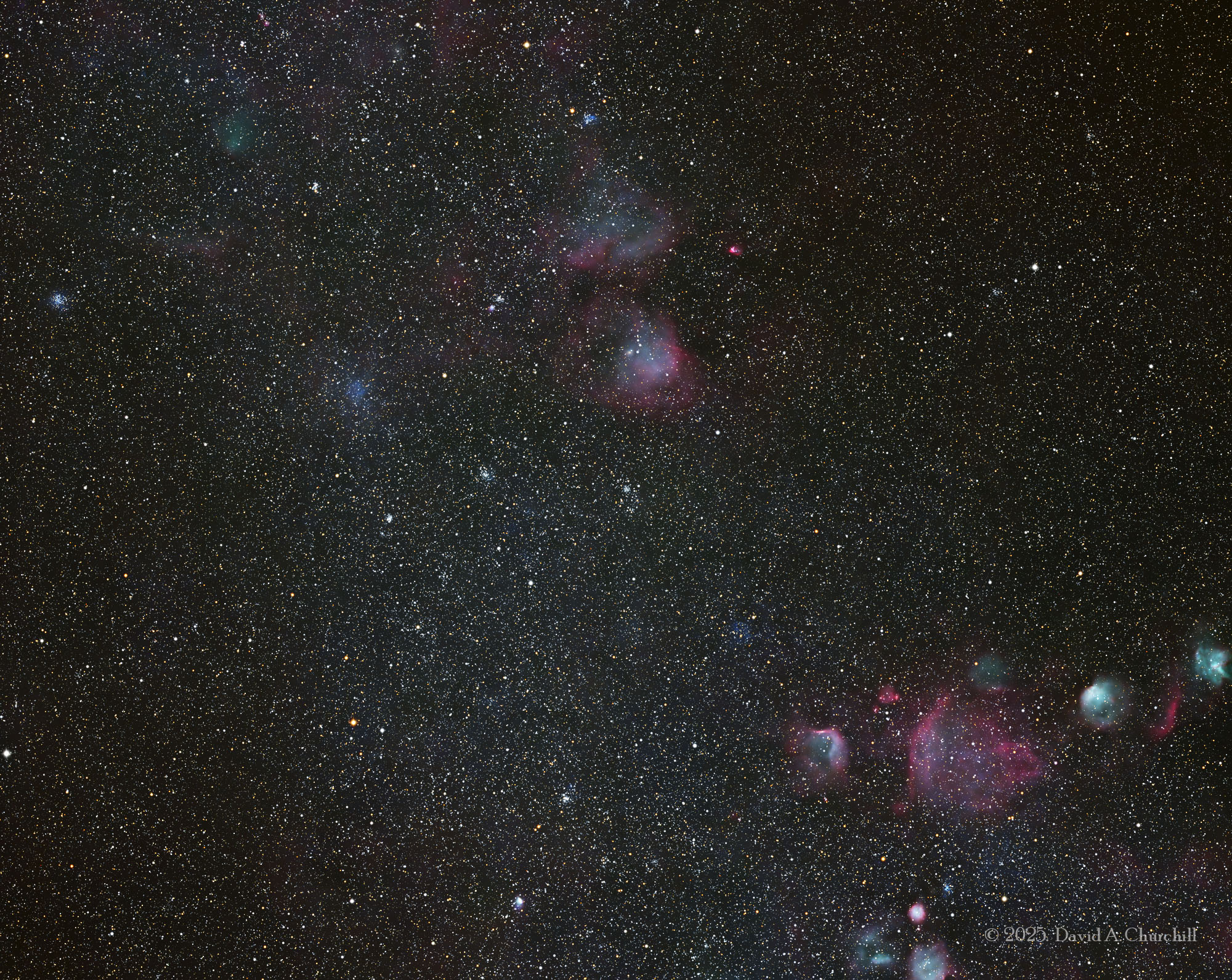
NGC 292 is the designation given to the Small Magellanic Cloud (SMC), a dwarf galaxy near the Milky Way. Classified as a dwarf irregular galaxy, the SMC has a D25 isophotal diameter of about 5.78 kiloparsecs (18,900 light-years), and contains several hundred million stars. It has a total mass of approximately 7 billion solar masses. At a distance of about 200,000 light-years, the SMC is among the nearest intergalactic neighbors of the Milky Way and is one of the most distant objects visible to the naked eye.
The SMC is visible from the entire Southern Hemisphere and can be fully glimpsed low above the southern horizon from latitudes south of about 15° north. The galaxy is located across the constellation of Tucana and part of Hydrus, appearing as a faint, hazy patch resembling a detached piece of the Milky Way. The SMC has an average apparent diameter of about 4.2° (8 times the Moon’s) and thus covers an area of about 14 square degrees (70 times the Moon’s). Since its surface brightness is very low, this deep-sky object is best seen on clear moonless nights and away from city lights. The SMC forms a pair with the Large Magellanic Cloud (LMC), which lies 20° to the east, and, like the LMC, is a member of the Local Group. It is currently a satellite of the Milky Way but is likely a former satellite of the LMC.
This image shows a number of objects within the LMC. NGC 290 is an open cluster of stars discovered September 5, 1826, by Scottish astronomer James Dunlop. The cluster is an estimated 30[5]–63[4] million years old and is around 65 light years across. NGC 249 is an emission nebula. It was discovered on 5 September 1826 by the astronomer James Dunlop. NGC 261 is a diffuse nebula, discovered on September 5, 1826, by James Dunlop. NGC 267 is an open cluster discovered on October 4, 1836, by John Herschel.
The SMC is visible from the entire Southern Hemisphere and can be fully glimpsed low above the southern horizon from latitudes south of about 15° north. The galaxy is located across the constellation of Tucana and part of Hydrus, appearing as a faint, hazy patch resembling a detached piece of the Milky Way. The SMC has an average apparent diameter of about 4.2° (8 times the Moon’s) and thus covers an area of about 14 square degrees (70 times the Moon’s). Since its surface brightness is very low, this deep-sky object is best seen on clear moonless nights and away from city lights. The SMC forms a pair with the Large Magellanic Cloud (LMC), which lies 20° to the east, and, like the LMC, is a member of the Local Group. It is currently a satellite of the Milky Way but is likely a former satellite of the LMC.
This image shows a number of objects within the LMC. NGC 290 is an open cluster of stars discovered September 5, 1826, by Scottish astronomer James Dunlop. The cluster is an estimated 30[5]–63[4] million years old and is around 65 light years across. NGC 249 is an emission nebula. It was discovered on 5 September 1826 by the astronomer James Dunlop. NGC 261 is a diffuse nebula, discovered on September 5, 1826, by James Dunlop. NGC 267 is an open cluster discovered on October 4, 1836, by John Herschel.
Telescope: Planewave CDK17 (FR) f4.5
Mount: Astro Physics 1600GTO
Camera: QHY16200A/ Integral FW
Guider: Agena Starguide II / ZWO ASI178MM
Filters: Astronomik 36mm LRGB
L: 83×10 mins = 830 mins, R: 30×10 mins = 300 mins, G: 30×10 mins = 300 mins, B: 28×10 mins = 280 mins
Total Imaging Time: 28h 30m
Data Imaged remotely on 9 nights during October & November, 2025.
Data acquisition & Processing by David Churchill.
None