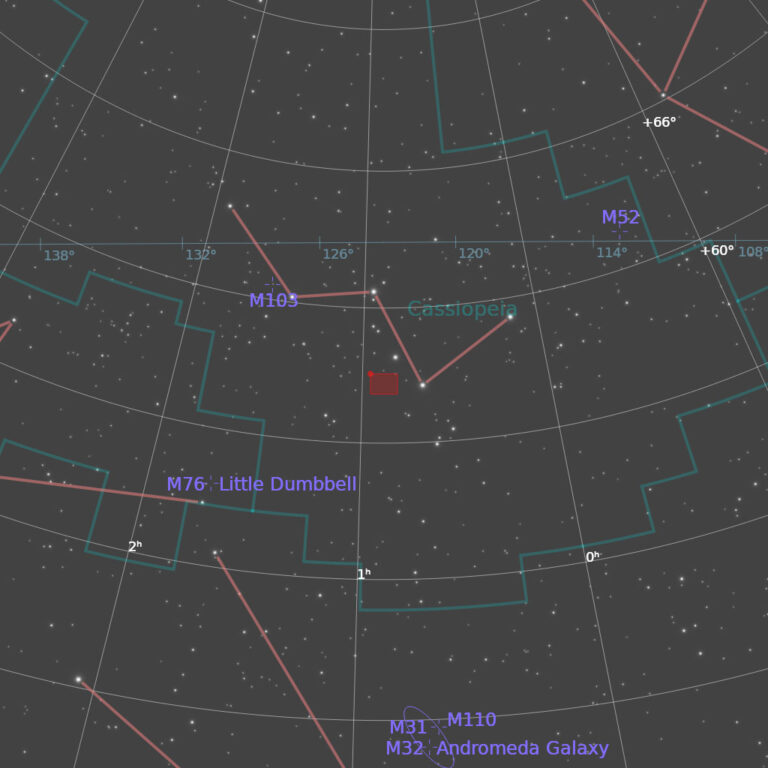
NGC 281
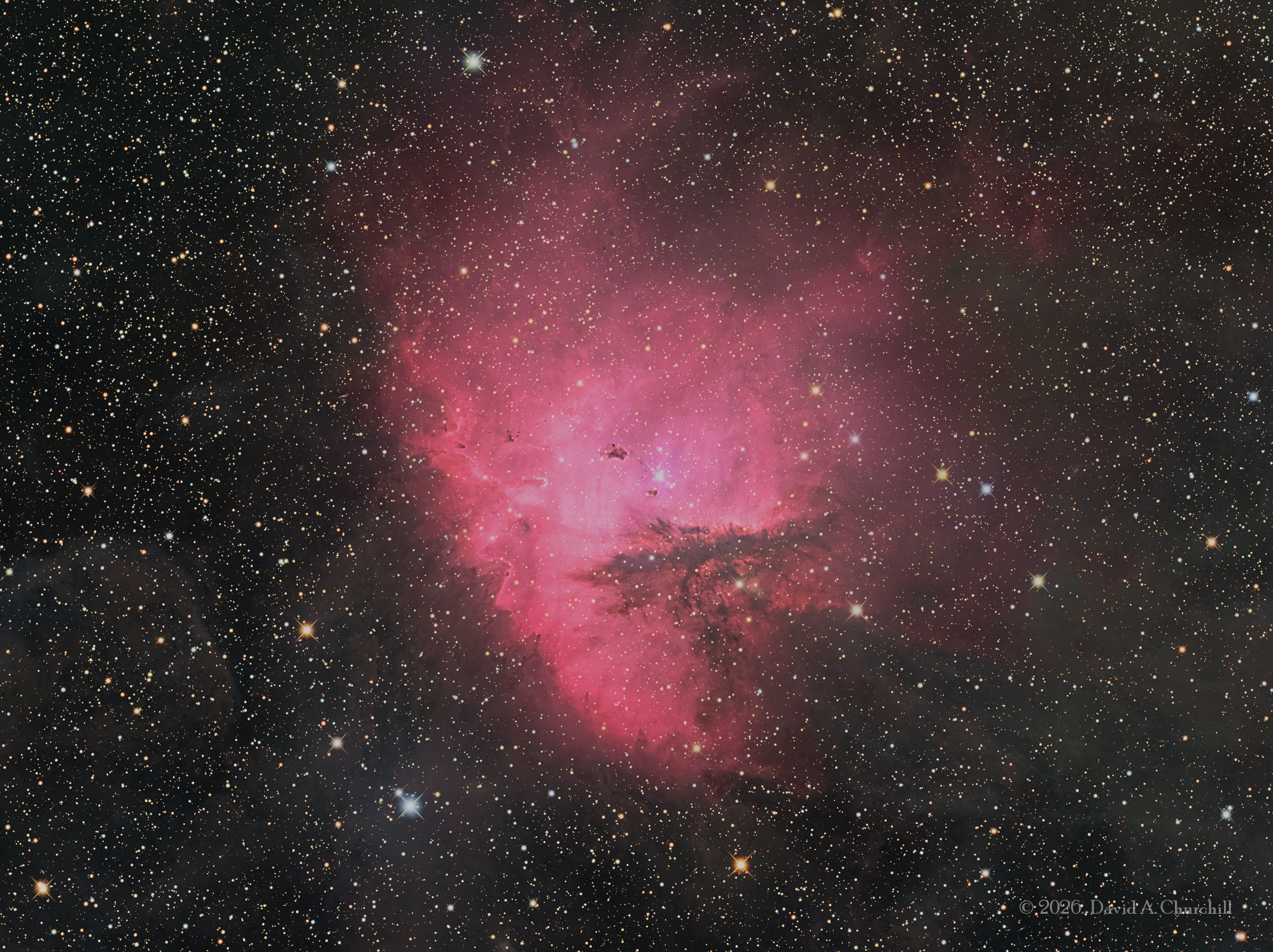
Pacman Nebula. Emission Nebula, Cassiopeia
January 2026. Cave Creek Canyon Observatory, Arizona Sky Village
- Description
- Technical
- Links
NGC 281, IC 11 or Sh2-184 is a bright emission nebula and part of an H II region in the northern constellation of Cassiopeia and is part of the Milky Way’s Perseus Spiral Arm. This 20×30 arcmin sized nebulosity is also associated with open cluster IC 1590, several Bok globules and the multiple star, B 1. It collectively forms Sh2-184, spanning over a larger area of 40 arcmin. A recent distance from radio parallaxes of water masers at 22 GHz made during 2014 is estimated it lies 2.82±0.20 kpc (9200 ly) from us. Colloquially, NGC 281 is also known as the Pacman Nebula for its resemblance to the video game character.
Edward Emerson Barnard discovered the nebula in August 1883, describing it as “a large faint nebula, very diffuse”. Multiple star ‘B 1’ or β 1 was later discovered by S. W. Burnham, whose bright component is identified as the highly luminous O6 spectral class star, HD 5005 or HIP 4121. It consists of an 8th-magnitude primary with four companions at distances between 1.4 and 15.7 arcsec. There has been no appreciable change in this quintuple system since the first measures were made in 1875.
Edward Emerson Barnard discovered the nebula in August 1883, describing it as “a large faint nebula, very diffuse”. Multiple star ‘B 1’ or β 1 was later discovered by S. W. Burnham, whose bright component is identified as the highly luminous O6 spectral class star, HD 5005 or HIP 4121. It consists of an 8th-magnitude primary with four companions at distances between 1.4 and 15.7 arcsec. There has been no appreciable change in this quintuple system since the first measures were made in 1875.
Telescope: Planewave Delta Rho 350 f3.0
Mount: Astro Physics 3600GTO “El Capitan”
Camera: ZWO ASI461MM pro / EFW-7
Guider: ZWO OAG-L-68 / ZWO ASI174mm Mini
Filters: Astrodon II 50mm Sq LRGB
L: 104×5 mins = 520 mins, R: 46×5 mins = 230 mins, G: 48×5 mins = 240 mins, B: 48×5 mins = 240 mins
Total Imaging Time: 20h 30m
Data Imaged remotely on 9 nights during December 2025 & January 2026.
Data acquisition & Processing by David Churchill.
None