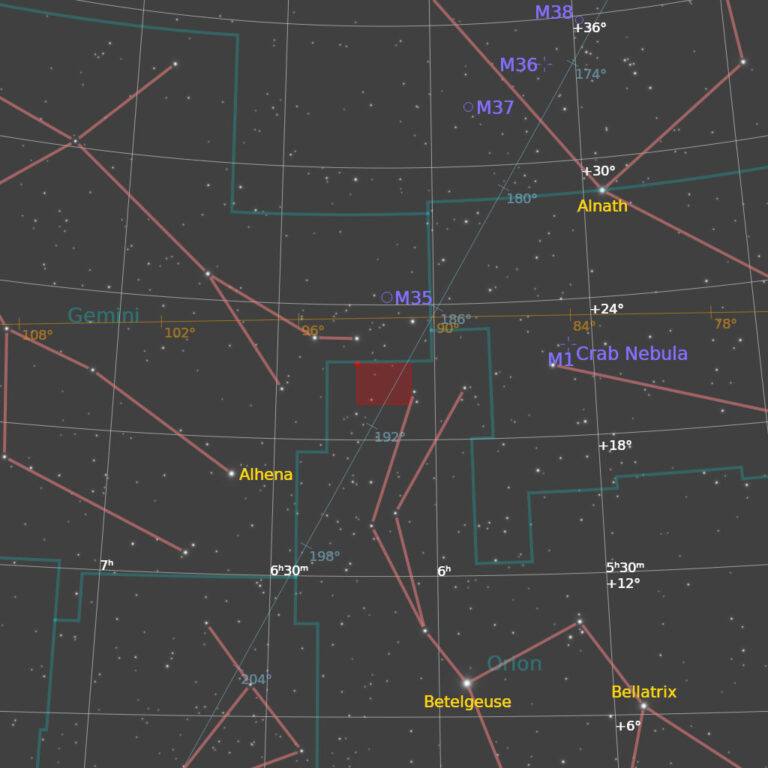
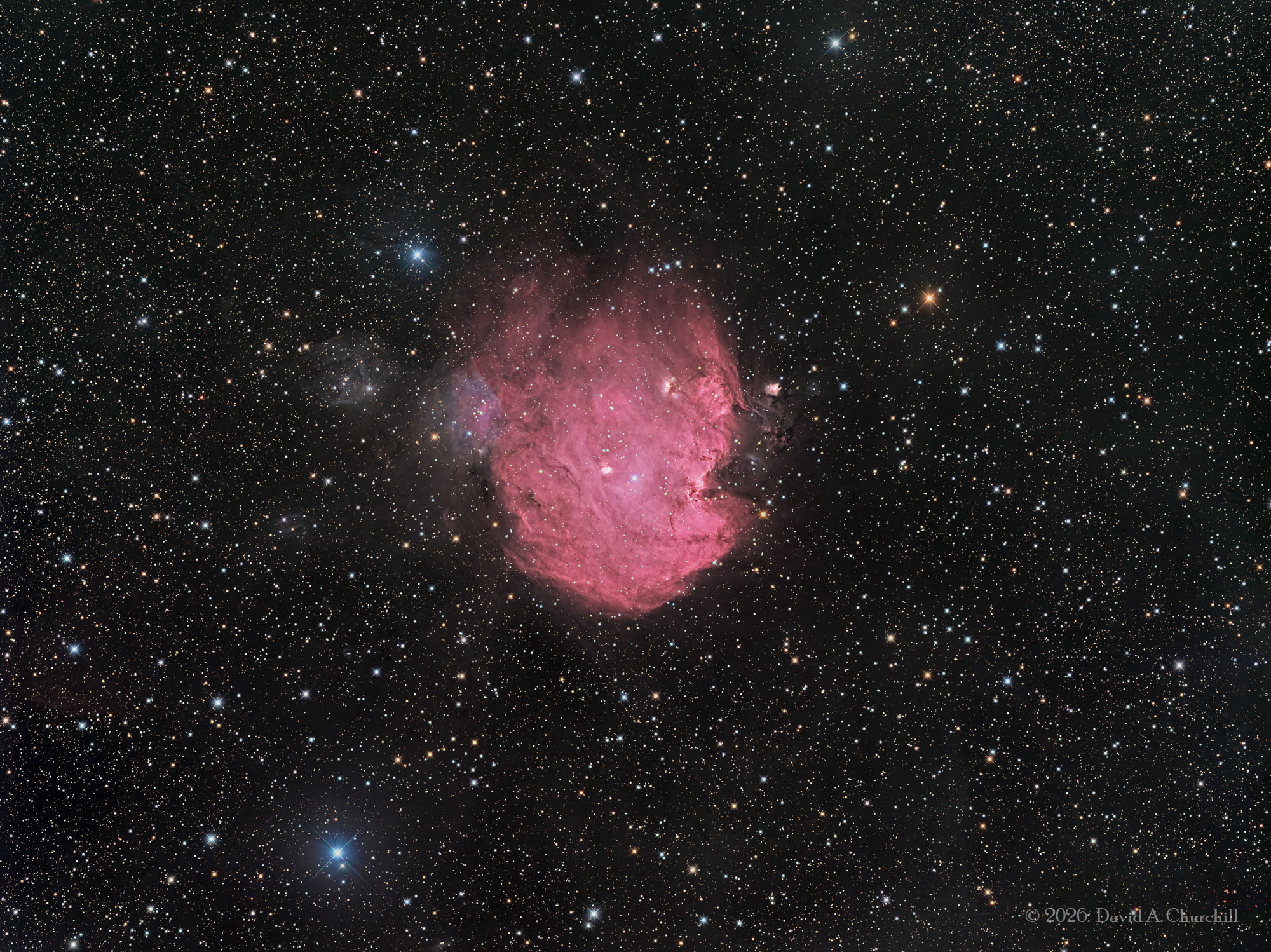
NGC 2175
Monkey Head Nebula. Open Cluster & Emission Nebula, Orion
March 2026. Cave Creek Canyon Observatory, Arizona Sky Village
- Description
- Technical
- Links
Open Cluster NGC 2175 (also known as OCL 476 or Cr 84) is an open cluster in the Orion constellation, embedded in a diffusion nebula. It was discovered by Giovanni Batista Hodierna before 1654 and independently discovered by Karl Christian Bruhns in 1857. NGC 2175 is at a distance of about 6,350 light years away from Earth. The nebula surrounding it is Sharpless catalog Sh 2-252, and it is sometimes called the Monkey Head Nebula due to its appearance.
There is some equivocation in the use of the identifiers NGC 2174 and NGC 2175. These may apply to the entire nebula, to its brightest knot, or to the star cluster it includes. Burnham’s Celestial Handbook lists the entire nebula as 2174/2175 and does not mention the star cluster.[1] The NGC Project (working from the original descriptive notes) assigns NGC 2174 to the prominent knot at J2000 06h 09m 23.7s, +20° 39′ 34″ and NGC 2175 to the entire nebula, and by extension to the star cluster. Simbad uses NGC 2174 for the nebula and NGC 2175 for the star cluster.
There is some equivocation in the use of the identifiers NGC 2174 and NGC 2175. These may apply to the entire nebula, to its brightest knot, or to the star cluster it includes. Burnham’s Celestial Handbook lists the entire nebula as 2174/2175 and does not mention the star cluster.[1] The NGC Project (working from the original descriptive notes) assigns NGC 2174 to the prominent knot at J2000 06h 09m 23.7s, +20° 39′ 34″ and NGC 2175 to the entire nebula, and by extension to the star cluster. Simbad uses NGC 2174 for the nebula and NGC 2175 for the star cluster.
Telescope: Planewave Delta Rho 350 f3.0
Mount: Astro Physics 3600GTO “El Capitan”
Camera: ZWO ASI461MM pro / EFW-7
Guider: ZWO OAG-L-68 / ZWO ASI174mm Mini
Filters: Astrodon II 50mm Sq LRGB
L: 150×5 mins = 750 mins, R: 42×5 mins = 210 mins, G: 30×5 mins = 150 mins, B: 45×5 mins = 225 mins
Total Imaging Time: 22h 15m
Data Imaged remotely on 10 nights during February & March 2026.
Data acquisition & Processing by David Churchill.
None