Messier 87
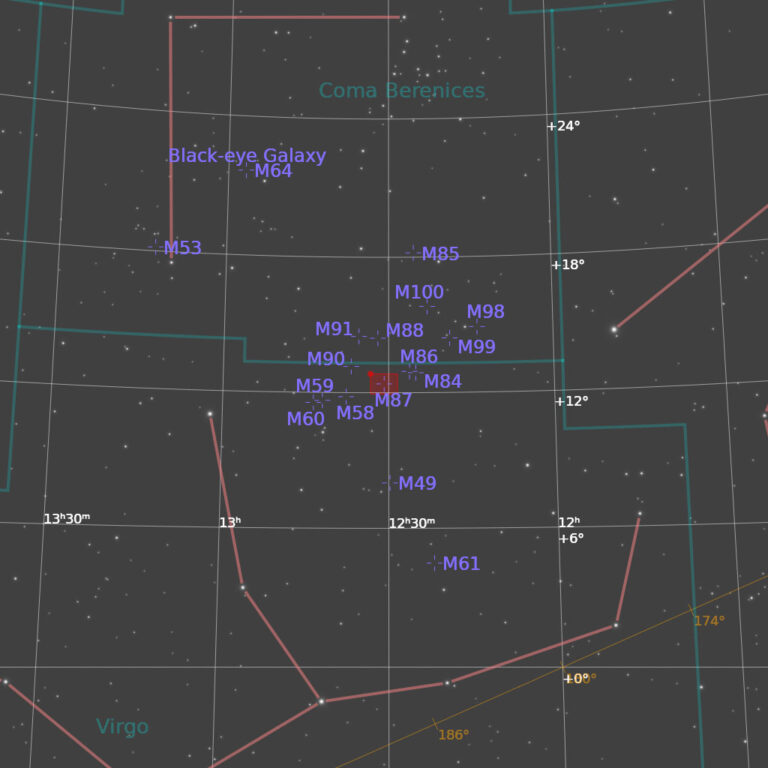
Virgo-A. Supergiant Elliptical Galaxy, Virgo
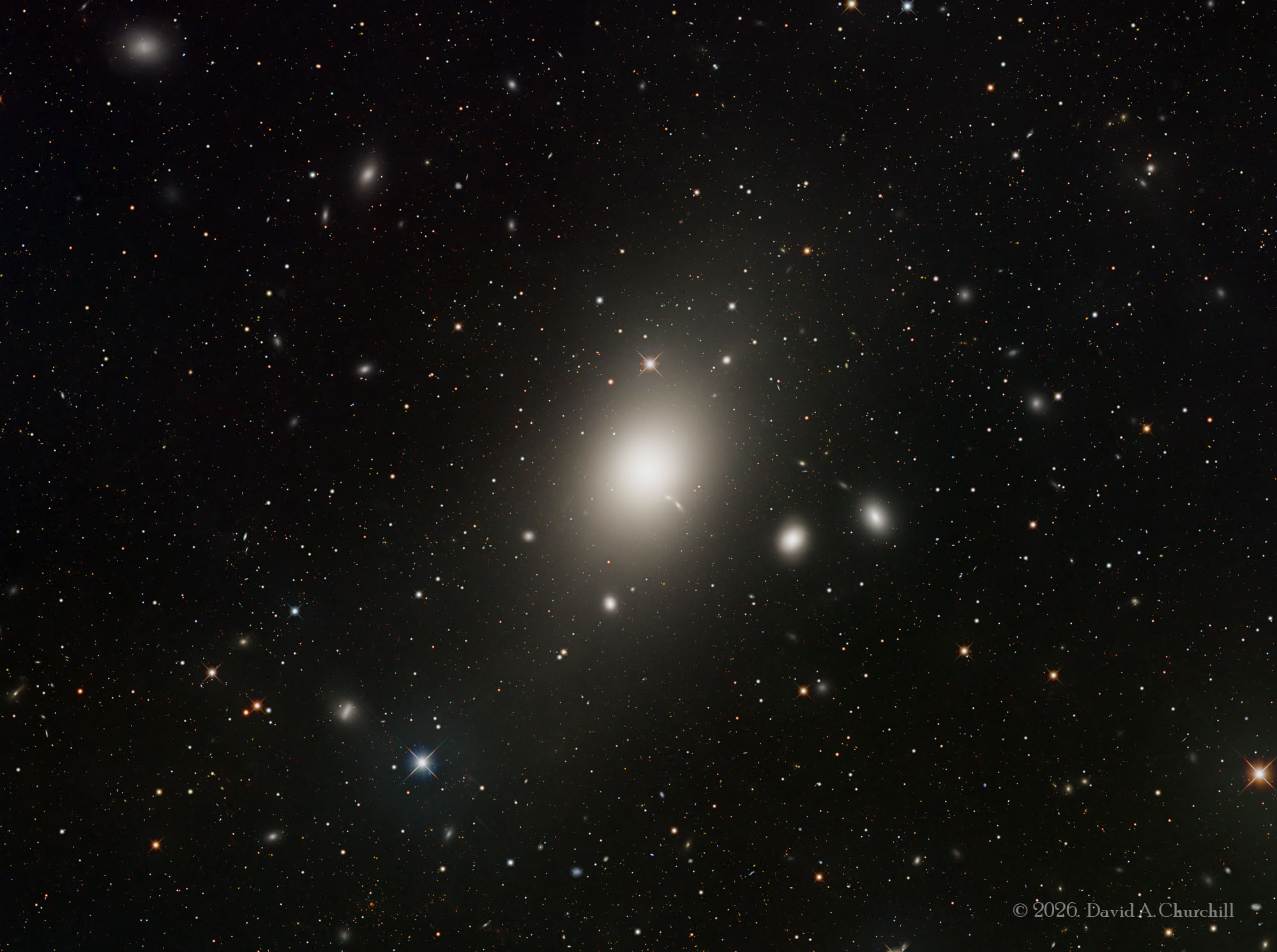
March 2026. Cave Creek Canyon Observatory, Arizona Sky Village
- Description
- Technical
- Links
Messier 87 (also known as Virgo A or NGC 4486, generally abbreviated to M87) is a supergiant elliptical galaxy in the constellation Virgo that contains several trillion stars. One of the largest and most massive galaxies in the local universe, it has a large population of globular clusters—about 15,000 compared with the 150–200 orbiting the Milky Way—and a jet of energetic plasma that originates at the core and extends at least 1,500 parsecs (4,900 light-years), traveling at a relativistic speed. It is one of the brightest radio sources in the sky and a popular target for both amateur and professional astronomers.
The French astronomer Charles Messier discovered M87 in 1781, and cataloged it as a nebula. M87 is about 16.4 million parsecs (53 million light-years) from Earth and is the second-brightest galaxy within the northern Virgo Cluster, having many satellite galaxies. Unlike a disk-shaped spiral galaxy, M87 has no distinctive dust lanes. Instead, it has an almost featureless, ellipsoidal shape typical of most giant elliptical galaxies, diminishing in luminosity with distance from the center. Forming around one-sixth of its mass, M87’s stars have a nearly spherically symmetric distribution. Their population density decreases with increasing distance from the core. It has an active supermassive black hole at its core, which forms the primary component of an active galactic nucleus. The black hole was imaged using data collected in 2017 by the Event Horizon Telescope (EHT), with a final, processed image released on 10 April 2019. In March 2021, the EHT Collaboration presented, for the first time, a polarized-based image of the black hole which may help better reveal the forces giving rise to quasars.
In 1781, the French astronomer Charles Messier published a catalogue of 103 objects that had a nebulous appearance as part of a list intended to identify objects that might otherwise be confused with comets. In subsequent use, each catalogue entry was prefixed with an “M”. Thus, M87 was the eighty-seventh object listed in Messier’s catalogue. During the 1880s, the object was included as NGC 4486 in the New General Catalogue of nebulae and star clusters assembled by the Danish-Irish astronomer John Dreyer, which he based primarily on the observations of the English astronomer John Herschel. In 1918, the American astronomer Heber Curtis of Lick Observatory noted M87’s lack of a spiral structure and observed a “curious straight ray … apparently connected with the nucleus by a thin line of matter.” The ray appeared brightest near the galactic center. In January 1922, Russian astronomer Innokentii A. Balanowski discovered supernova SN 1919A (type unknown, mag. 11.5) on a photographic plate of M87 that had been taken on 22 February 1919.
The French astronomer Charles Messier discovered M87 in 1781, and cataloged it as a nebula. M87 is about 16.4 million parsecs (53 million light-years) from Earth and is the second-brightest galaxy within the northern Virgo Cluster, having many satellite galaxies. Unlike a disk-shaped spiral galaxy, M87 has no distinctive dust lanes. Instead, it has an almost featureless, ellipsoidal shape typical of most giant elliptical galaxies, diminishing in luminosity with distance from the center. Forming around one-sixth of its mass, M87’s stars have a nearly spherically symmetric distribution. Their population density decreases with increasing distance from the core. It has an active supermassive black hole at its core, which forms the primary component of an active galactic nucleus. The black hole was imaged using data collected in 2017 by the Event Horizon Telescope (EHT), with a final, processed image released on 10 April 2019. In March 2021, the EHT Collaboration presented, for the first time, a polarized-based image of the black hole which may help better reveal the forces giving rise to quasars.
In 1781, the French astronomer Charles Messier published a catalogue of 103 objects that had a nebulous appearance as part of a list intended to identify objects that might otherwise be confused with comets. In subsequent use, each catalogue entry was prefixed with an “M”. Thus, M87 was the eighty-seventh object listed in Messier’s catalogue. During the 1880s, the object was included as NGC 4486 in the New General Catalogue of nebulae and star clusters assembled by the Danish-Irish astronomer John Dreyer, which he based primarily on the observations of the English astronomer John Herschel. In 1918, the American astronomer Heber Curtis of Lick Observatory noted M87’s lack of a spiral structure and observed a “curious straight ray … apparently connected with the nucleus by a thin line of matter.” The ray appeared brightest near the galactic center. In January 1922, Russian astronomer Innokentii A. Balanowski discovered supernova SN 1919A (type unknown, mag. 11.5) on a photographic plate of M87 that had been taken on 22 February 1919.
Telescope: Planewave Delta Rho 350 f3.0
Mount: Astro Physics 3600GTO “El Capitan”
Camera: ZWO ASI461MM pro / EFW-7
Guider: ZWO OAG-L-68 / ZWO ASI174mm Mini
Filters: Astrodon II 50mm Sq LRGB
L: 106×5 mins = 530 mins, R: 60×5 mins = 300 mins, G: 45×5 mins = 225 mins, B: 48×5 mins = 240 mins
Total Imaging Time: 21h 35m
Data Imaged remotely on 11 nights during March 2026.
Data acquisition & Processing by David Churchill.
None