Messier 67
Open Cluster, Cancer
February 2026. Cave Creek Canyon Observatory, Arizona Sky Village
- Description
- Technical
- Links
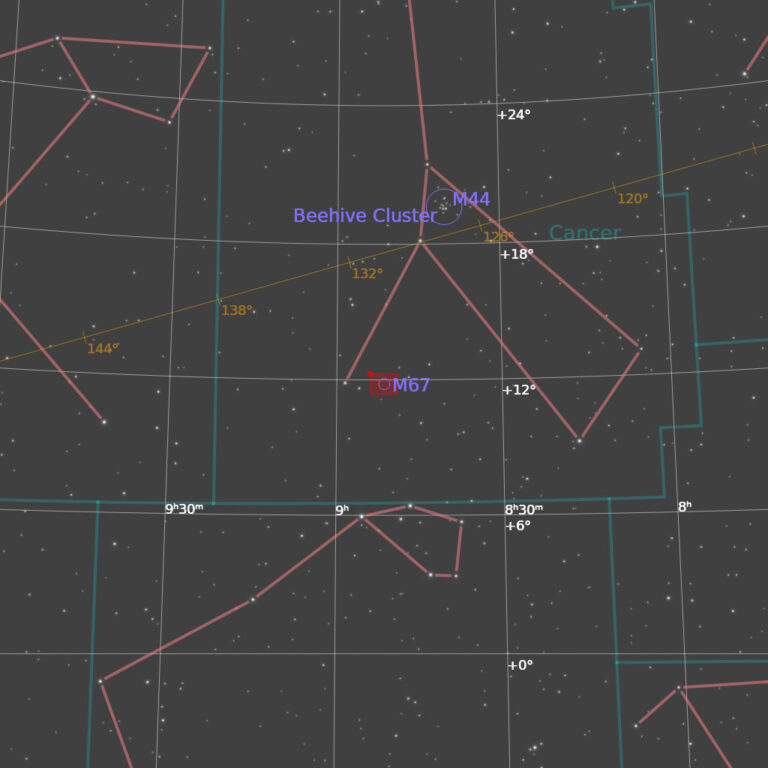
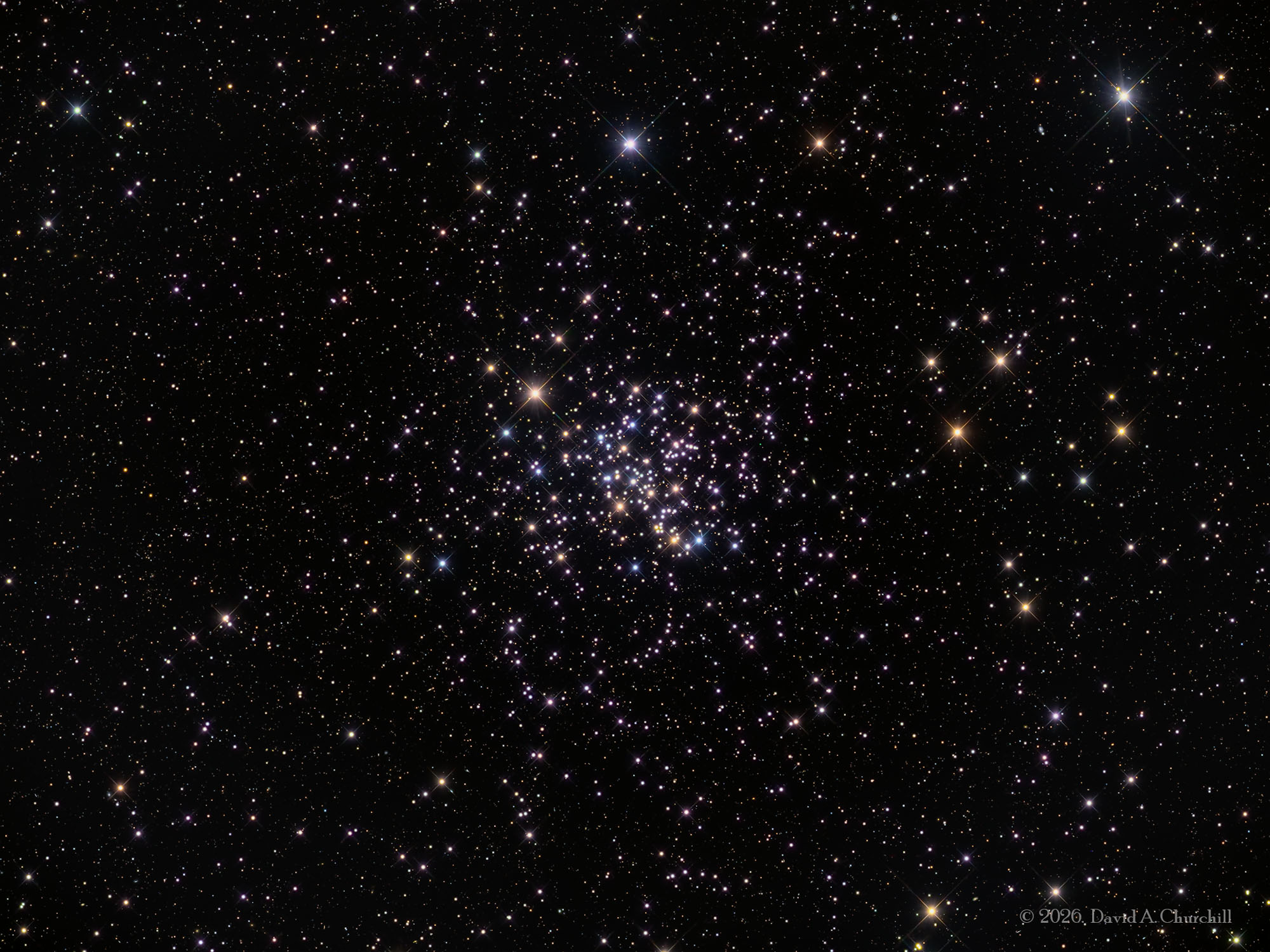
Messier 67 (also known as M67 or NGC 2682) and sometimes called the King Cobra Cluster or the Golden Eye Cluster is an open cluster in the southern, equatorial half of Cancer. It was discovered by Johann Gottfried Koehler in 1779. M67 is not the oldest known open cluster, several Milky Way clusters are known to be older, yet farther than M67. M67 is one of the most-studied open clusters, yet estimates of its physical parameters such as age, mass, and number of stars of a given type, vary substantially. Richer et al. estimate its age to be 4 billion years, its mass to be 1080 solar masses (M☉), and number its white dwarfs at 150. Hurley et al. estimate its current mass to be 1,400 M☉ and its initial mass to be approximately 10 times as great.
It has more than 100 stars similar to the Sun, and numerous red giants. The total star count has been estimated at well over 500. The ages and prevalence of Sun-like stars had led some astronomers to theorize it as the possible parent cluster of the Sun. However, computer simulations disagree on whether the outer Solar System would have survived an ejection from M67, and the cluster itself would probably not have survived such an ejection event.
The cluster contains no main sequence stars bluer (hotter) than spectral type F, other than perhaps some of the blue stragglers, since the brighter stars of that age have already left the main sequence. In fact, when the stars of the cluster are plotted on the Hertzsprung-Russell diagram, there is a distinct “turn-off” representing the stars which have terminated hydrogen fusion in the core and are destined to become red giants. As a cluster ages, the turn-off moves progressively down the main sequence to cooler stars. It appears that M67 has a bias toward heavier stars. One cause of this is mass segregation, the process by which lighter stars gain speed at the expense of more massive stars during close encounters, which moves them to greater average distance from the center of the cluster or allows escape altogether.
It has more than 100 stars similar to the Sun, and numerous red giants. The total star count has been estimated at well over 500. The ages and prevalence of Sun-like stars had led some astronomers to theorize it as the possible parent cluster of the Sun. However, computer simulations disagree on whether the outer Solar System would have survived an ejection from M67, and the cluster itself would probably not have survived such an ejection event.
The cluster contains no main sequence stars bluer (hotter) than spectral type F, other than perhaps some of the blue stragglers, since the brighter stars of that age have already left the main sequence. In fact, when the stars of the cluster are plotted on the Hertzsprung-Russell diagram, there is a distinct “turn-off” representing the stars which have terminated hydrogen fusion in the core and are destined to become red giants. As a cluster ages, the turn-off moves progressively down the main sequence to cooler stars. It appears that M67 has a bias toward heavier stars. One cause of this is mass segregation, the process by which lighter stars gain speed at the expense of more massive stars during close encounters, which moves them to greater average distance from the center of the cluster or allows escape altogether.
Telescope: Planewave Delta Rho 350 f3.0
Mount: Astro Physics 3600GTO “El Capitan”
Camera: ZWO ASI461MM pro / EFW-7
Guider: ZWO OAG-L-68 / ZWO ASI174mm Mini
Filters: Astrodon II 50mm Sq LRGB
L: 41×5 mins = 205 mins, R: 24×5 mins = 120 mins, G: 24×5 mins = 120 mins, B: 24×5 mins = 120 mins
Total Imaging Time: 9h 25m
Data Imaged remotely on 4 nights during February 2026.
Data acquisition & Processing by David Churchill.
None