Messier 27
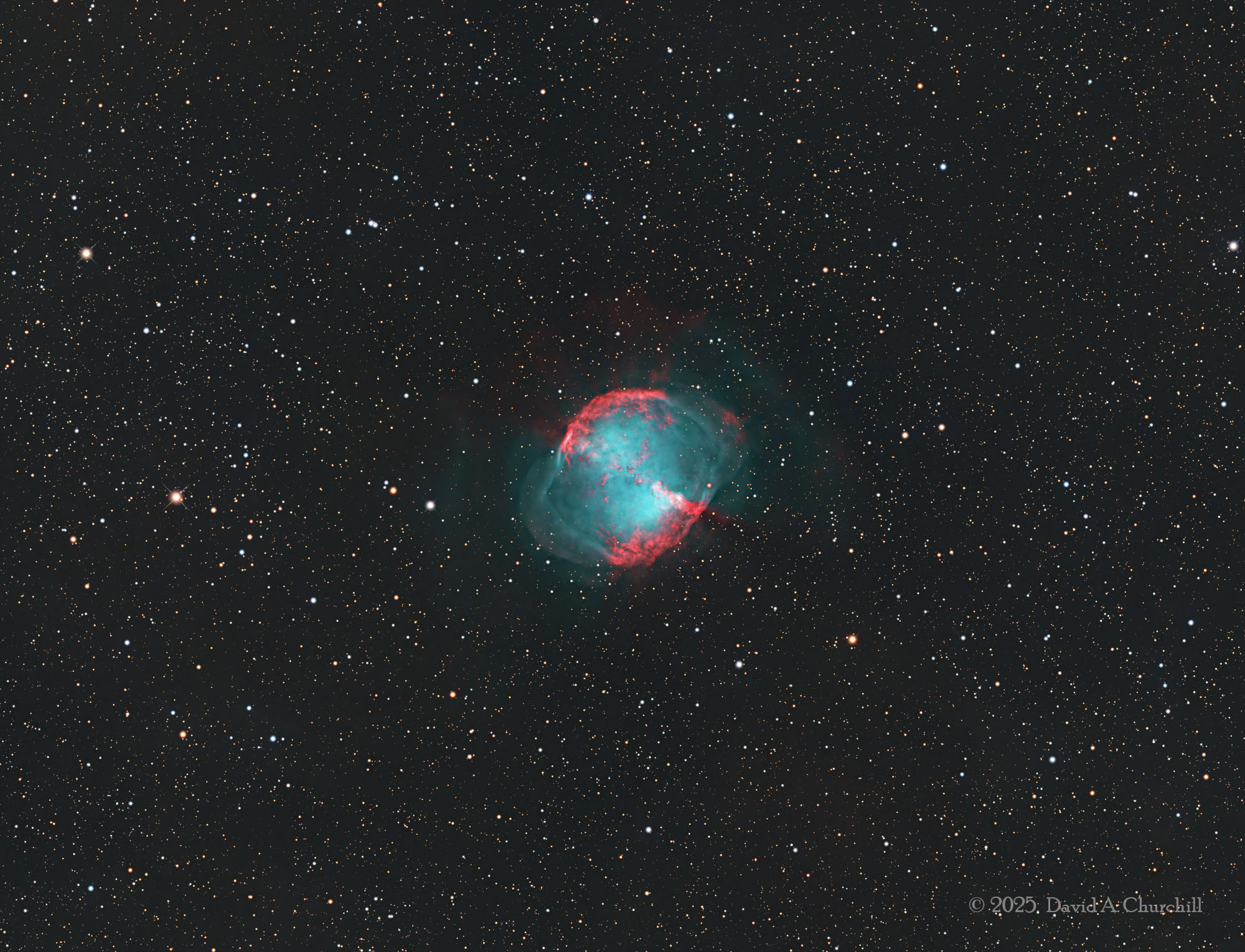
The Dumbbell Nebula. Planetary Nebula, Vulpecula
October 2025. Cave Creek Canyon Observatory, Arizona Sky Village
- Description
- Technical
- Links
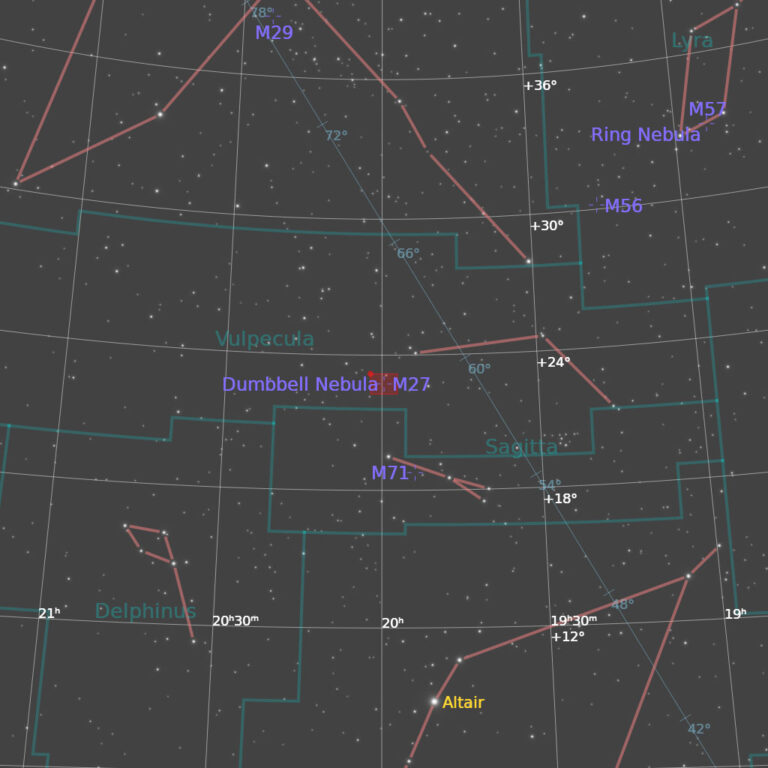
The Dumbbell Nebula (also known as the Apple Core Nebula, Messier 27, and NGC 6853) is a planetary nebula (nebulosity surrounding a white dwarf) in the constellation Vulpecula, at a distance of about 1360 light-years. It was the first such nebula to be discovered, by Charles Messier in 1764. At its brightness of visual magnitude 7.5 and diameter of about 8 arcminutes, it is easily visible in binoculars and is a popular observing target in amateur telescopes.
The Dumbbell Nebula appears shaped like a prolate spheroid and is viewed from our perspective along the plane of its equator. In 1992, Moreno-Corral et al. computed that its rate of expansion angularly was, viewed from our distance, no more than 2.3 arcseconds (″) per century. From this, an upper limit to the age of 14,600 years may be determined. In 1970, Bohuski, Smith, and Weedman found an expansion velocity of 31 km/s. Given its semi-minor axis radius of 1.01 ly, this implies that the kinematic age of the nebula is 9,800 years.
Like many nearby planetary nebulae, the Dumbbell contains knots. Its central region is marked by a pattern of dark and bright cusped knots and their associated dark tails. The knots vary in appearance from symmetric objects with tails to rather irregular tail-less objects. Similarly to the Helix Nebula and the Eskimo Nebula, the heads of the knots have bright cusps which are local photoionization fronts. The central star, a white dwarf progenitor, is estimated to have a radius which is 0.055±0.02 R☉ (0.13 light seconds) which gives it a size larger than most other known white dwarfs. Its mass was estimated in 1999 by Napiwotzki to be 0.56±0.01 M☉.
The Dumbbell Nebula appears shaped like a prolate spheroid and is viewed from our perspective along the plane of its equator. In 1992, Moreno-Corral et al. computed that its rate of expansion angularly was, viewed from our distance, no more than 2.3 arcseconds (″) per century. From this, an upper limit to the age of 14,600 years may be determined. In 1970, Bohuski, Smith, and Weedman found an expansion velocity of 31 km/s. Given its semi-minor axis radius of 1.01 ly, this implies that the kinematic age of the nebula is 9,800 years.
Like many nearby planetary nebulae, the Dumbbell contains knots. Its central region is marked by a pattern of dark and bright cusped knots and their associated dark tails. The knots vary in appearance from symmetric objects with tails to rather irregular tail-less objects. Similarly to the Helix Nebula and the Eskimo Nebula, the heads of the knots have bright cusps which are local photoionization fronts. The central star, a white dwarf progenitor, is estimated to have a radius which is 0.055±0.02 R☉ (0.13 light seconds) which gives it a size larger than most other known white dwarfs. Its mass was estimated in 1999 by Napiwotzki to be 0.56±0.01 M☉.
Telescope: Planewave Delta Rho 350 f3.0
Mount: Astro Physics 3600GTO “El Capitan”
Camera: ZWO ASI461MM pro / EFW-7
Guider: ZWO OAG-L-68 / ZWO ASI174mm Mini
Filters: Astrodon II 50mm Sq LRGB
L: 90×5 mins = 450 mins, R: 48×5 mins = 240 mins, G: 48×5 mins = 240 mins, B: 48×5 mins = 240 mins
Total Imaging Time: 19h 30m
Data Imaged remotely on 12 nights during August to October, 2025.
Data acquisition & Processing by David Churchill.