Messier 95
Barred Spiral Galaxy, Leo
April 2026. Cave Creek Canyon Observatory, Arizona Sky Village
- Description
- Technical
- Links
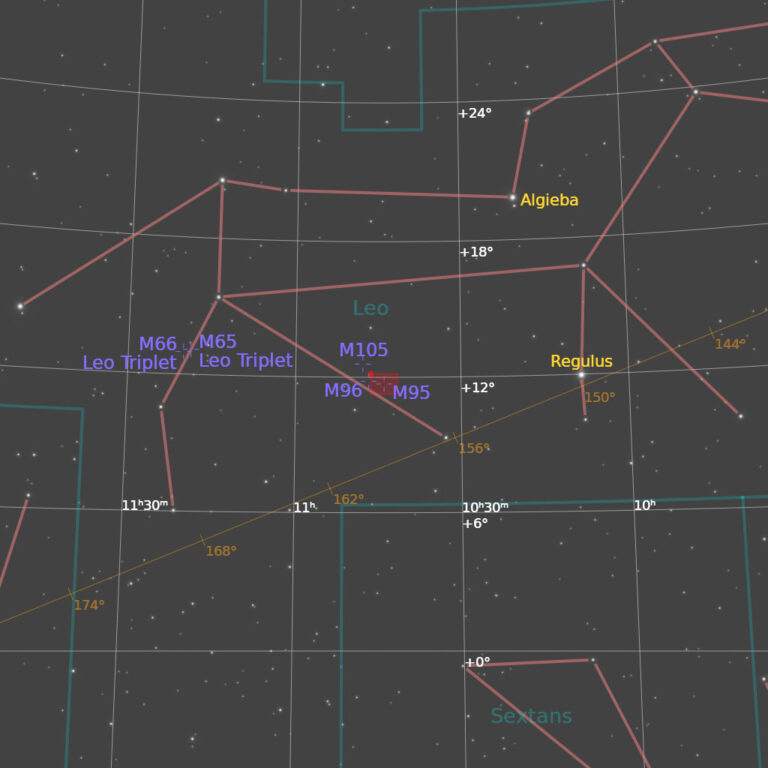
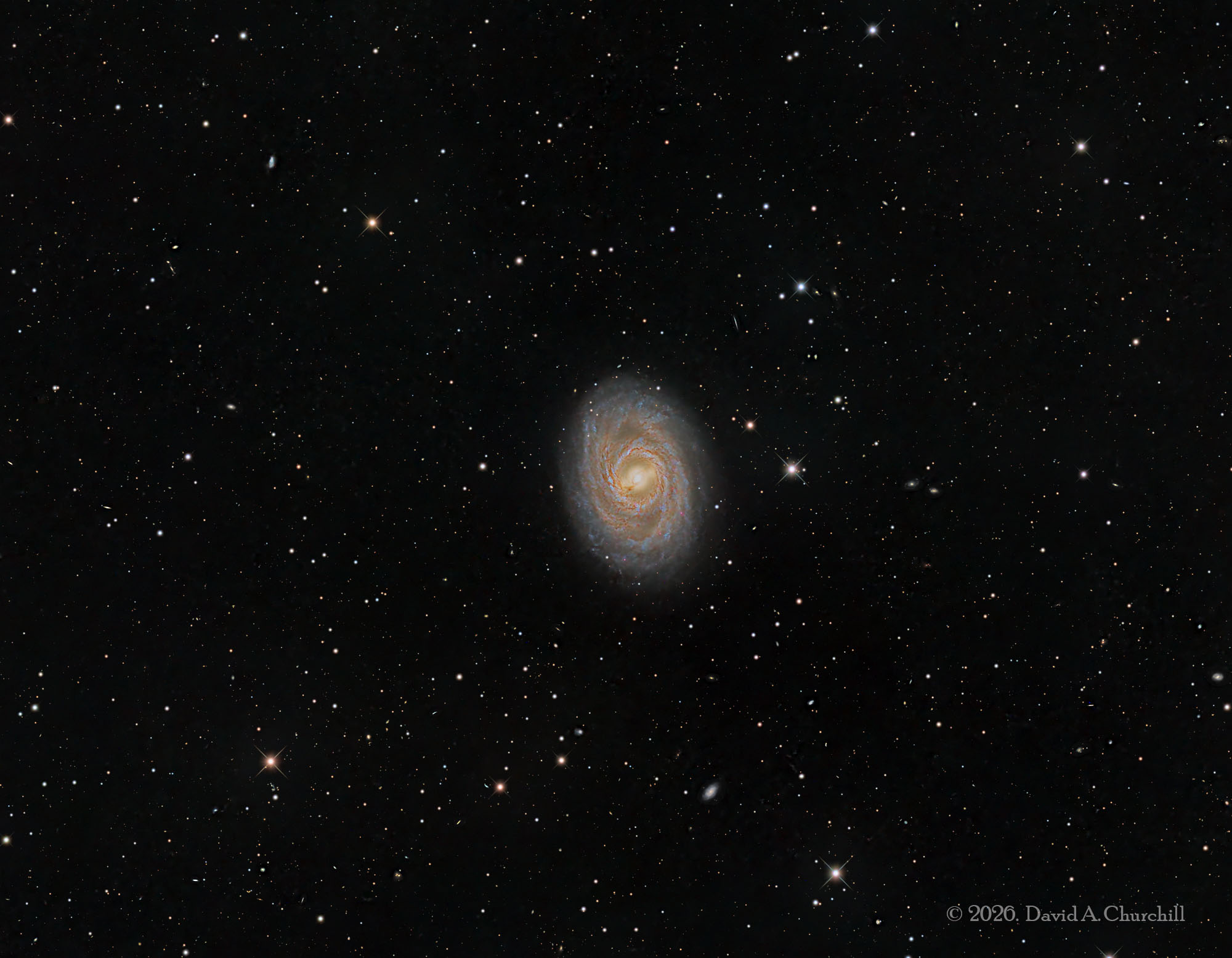
Messier 95, also known as M95 or NGC 3351, is a barred spiral galaxy about 33 million light-years away in the zodiac constellation Leo. It was discovered by Pierre Méchain in 1781, and catalogued by compatriot Charles Messier four days later. In 2012 its most recent supernova was discovered.
The galaxy has a morphological classification of SB(r)b, with the SBb notation indicating it is a barred spiral with arms that are intermediate on the scale from tightly to loosely wound, and an “(r)” meaning an inner ring surrounds the bar. The latter is a ring-shaped, circumnuclear star-forming region with a diameter of approximately 70,000 light-years (21,000 pc) and a thickness of around 2,400 light-years (750 pc). The spiral structure extends outward from the ring.
Its ring structure is about 3.5×10⁸ M☉ (solar masses) in molecular gas and yields a star formation rate of 0.38 M☉ yr−1. The star formation is occurring in at least five regions with diameters between 100 and 150 pc that are composed of several star clusters ranging in size from 1.7 to 4.9 pc. These individual clusters contain (1.8–8.7)×106 M☉ of stars, and may be on the path to forming globular clusters.
M95 is one of several galaxies within the M96 Group, a group of galaxies in the constellation Leo, the other Messier objects of which are M96 and M105.
The galaxy has a morphological classification of SB(r)b, with the SBb notation indicating it is a barred spiral with arms that are intermediate on the scale from tightly to loosely wound, and an “(r)” meaning an inner ring surrounds the bar. The latter is a ring-shaped, circumnuclear star-forming region with a diameter of approximately 70,000 light-years (21,000 pc) and a thickness of around 2,400 light-years (750 pc). The spiral structure extends outward from the ring.
Its ring structure is about 3.5×10⁸ M☉ (solar masses) in molecular gas and yields a star formation rate of 0.38 M☉ yr−1. The star formation is occurring in at least five regions with diameters between 100 and 150 pc that are composed of several star clusters ranging in size from 1.7 to 4.9 pc. These individual clusters contain (1.8–8.7)×106 M☉ of stars, and may be on the path to forming globular clusters.
M95 is one of several galaxies within the M96 Group, a group of galaxies in the constellation Leo, the other Messier objects of which are M96 and M105.
Telescope: Planewave Delta Rho 350 f3.0
Mount: Astro Physics 3600GTO “El Capitan”
Camera: ZWO ASI461MM pro / EFW-7
Guider: ZWO OAG-L-68 / ZWO ASI174mm Mini
Filters: Astrodon II 50mm Sq LRGB
L: 117×5 mins = 585 mins, R: 48×5 mins = 240 mins, G: 48×5 mins = 240 mins, B: 48×5 mins = 240 mins
Total Imaging Time: 21h 45m
Data Imaged remotely on 6 nights during April 2026.
Data acquisition & Processing by David Churchill.
None