Messier 81 & Messier 82
Bode's & Cigar. Grand-Spiral & Starburst Galaxies, Ursa Major
March 2026. Cave Creek Canyon Observatory, Arizona Sky Village
- Description
- Technical
- Links
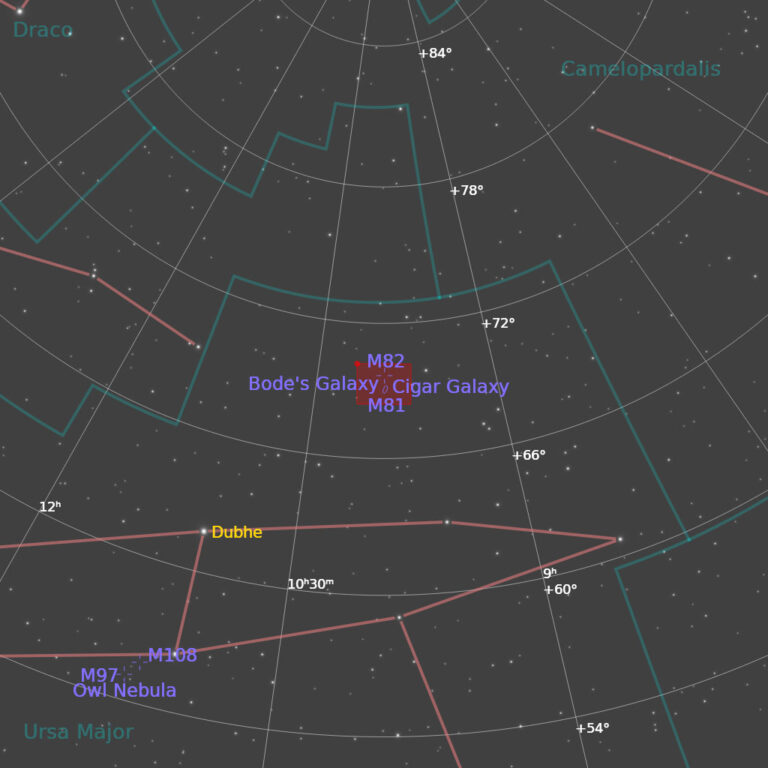
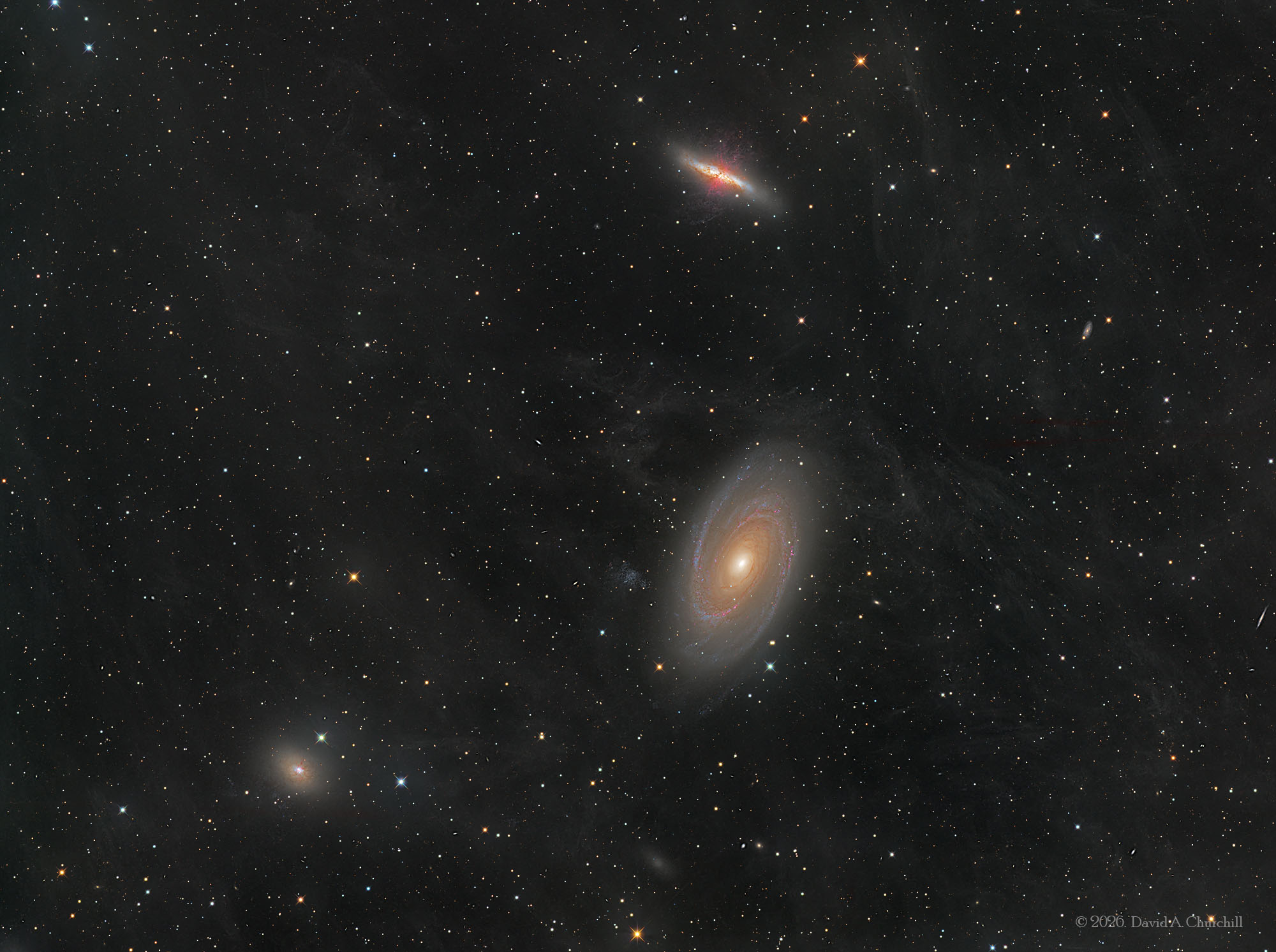
Messier 81 (also known as M81, NGC 3031 or Bode’s Galaxy) is a grand design spiral galaxy about 12 million light-years away in the constellation Ursa Major. M81 was first discovered by Johann Elert Bode on 31 December 1774. Thus, it is sometimes referred to as “Bode’s Galaxy”. In 1779, Pierre Méchain and Charles Messier reidentified Bode’s object, hence listed it in the Messier Catalogue. The galaxy is to be found approximately 10° northwest of Alpha Ursae Majoris (Dubhe) along with several other galaxies in the Messier 81 Group.
Messier 82 (also known as NGC 3034, Cigar Galaxy or M82) is a starburst galaxy approximately 12 million light-years away in the constellation Ursa Major. It is the second-largest member of the M81 Group, and was discovered at the same time as M81.
NGC 3077 is a small disrupted elliptical galaxy, and a member of the M81 Group. Despite being similar to an elliptical galaxy in appearance, it is peculiar for two reasons. First, it shows wispy edges and scattered dust clouds that are probably a result of gravitational interaction with its larger neighbors, similar to the galaxy M82. Second, this galaxy has an active nucleus. This caused Carl Seyfert in 1943 to include it in his list of galaxies, which are now called Seyfert Galaxies. However, NGC 3077, though an emission line galaxy, is today no longer classified as a Seyfert galaxy.
NGC 3077 was discovered by William Herschel on November 8, 1801. He remarked that “On the nF (NE) side, there is a faint ray interrupting the roundness.” Admiral Smyth described it as “A bright-class round nebula; it is a lucid white, and lights up in the centre … between these [stars,] the sky is intensely black, and shows the nebula as if floating in awful and illimitable space, at an inconceivable distance.”
Messier 81 and Messier 82 are considered ideal for viewing using binoculars and small telescopes. The two objects are generally not observable to the unaided eye, although highly experienced amateur astronomers may be able to see Messier 81 under exceptional observing conditions with a very dark sky. Telescopes with apertures of 8 inches (20 cm) or larger are needed to distinguish structures in the galaxies. NGC 3077 is a much harder object to observe visually, but shows up well in images of the Messier pair.
Messier 82 (also known as NGC 3034, Cigar Galaxy or M82) is a starburst galaxy approximately 12 million light-years away in the constellation Ursa Major. It is the second-largest member of the M81 Group, and was discovered at the same time as M81.
NGC 3077 is a small disrupted elliptical galaxy, and a member of the M81 Group. Despite being similar to an elliptical galaxy in appearance, it is peculiar for two reasons. First, it shows wispy edges and scattered dust clouds that are probably a result of gravitational interaction with its larger neighbors, similar to the galaxy M82. Second, this galaxy has an active nucleus. This caused Carl Seyfert in 1943 to include it in his list of galaxies, which are now called Seyfert Galaxies. However, NGC 3077, though an emission line galaxy, is today no longer classified as a Seyfert galaxy.
NGC 3077 was discovered by William Herschel on November 8, 1801. He remarked that “On the nF (NE) side, there is a faint ray interrupting the roundness.” Admiral Smyth described it as “A bright-class round nebula; it is a lucid white, and lights up in the centre … between these [stars,] the sky is intensely black, and shows the nebula as if floating in awful and illimitable space, at an inconceivable distance.”
Messier 81 and Messier 82 are considered ideal for viewing using binoculars and small telescopes. The two objects are generally not observable to the unaided eye, although highly experienced amateur astronomers may be able to see Messier 81 under exceptional observing conditions with a very dark sky. Telescopes with apertures of 8 inches (20 cm) or larger are needed to distinguish structures in the galaxies. NGC 3077 is a much harder object to observe visually, but shows up well in images of the Messier pair.
Telescope: Planewave Delta Rho 350 f3.0
Mount: Astro Physics 3600GTO “El Capitan”
Camera: ZWO ASI461MM pro / EFW-7
Guider: ZWO OAG-L-68 / ZWO ASI174mm Mini
Filters: Astrodon II 50mm Sq LRGB
L: 114×5 mins = 570 mins, R: 48×5 mins = 240 mins, G: 48×5 mins = 240 mins, B: 48×5 mins = 240 mins
Total Imaging Time: 21h 30m
Data Imaged remotely on 5 nights during March 2026.
Data acquisition & Processing by David Churchill.
None